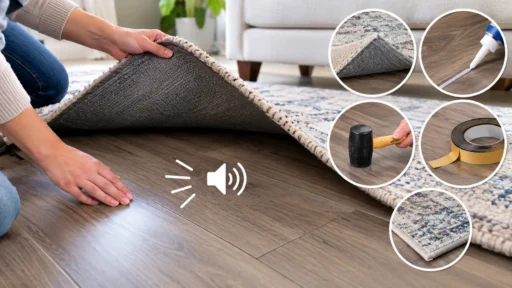
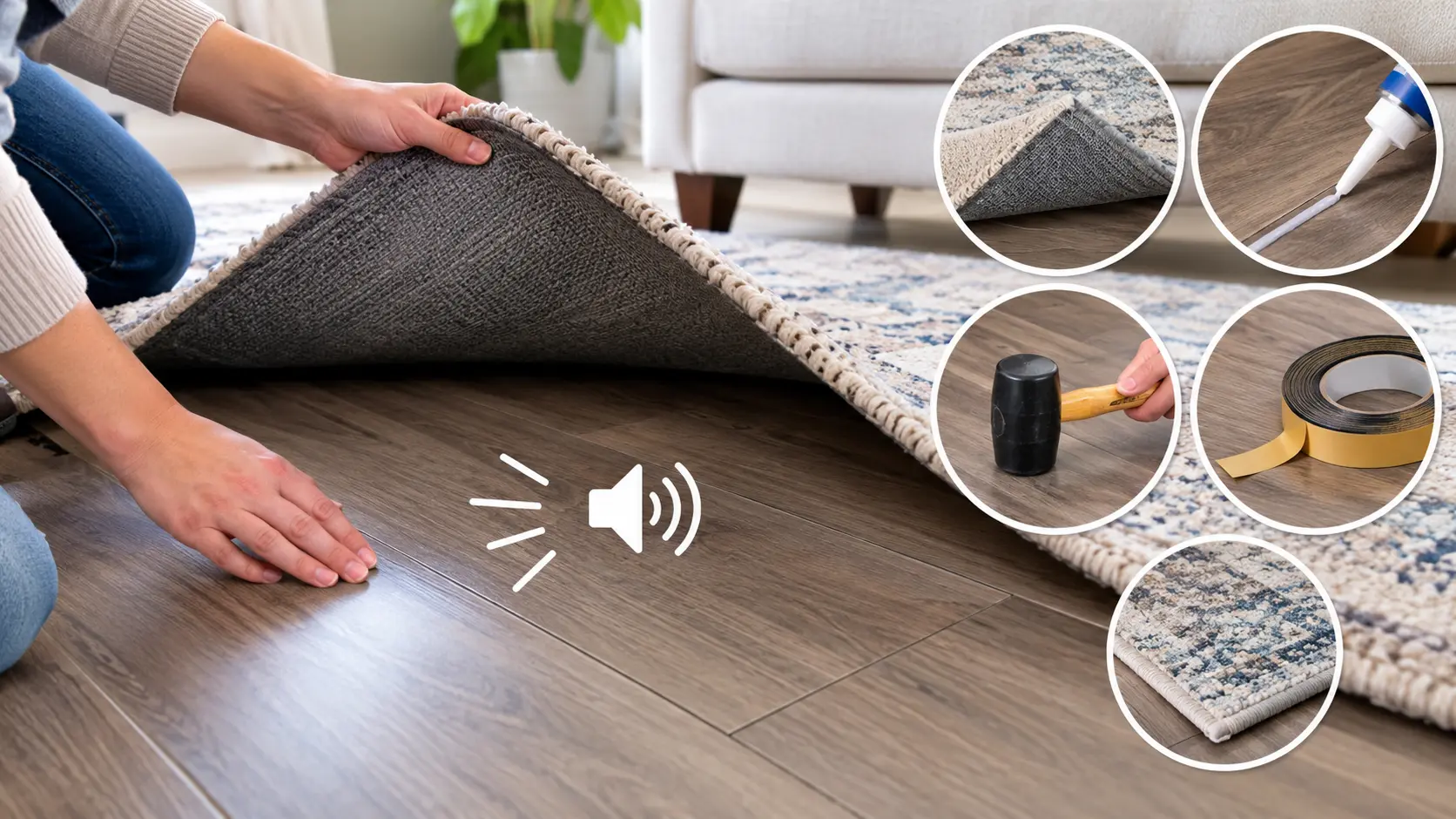

Quick answer: How to fix squeaking vinyl plank flooring under a rug is easier than you might think. Most squeaks under a rug on vinyl plank flooring come from friction between the rug pad and the plank, a loose click-lock seam, or a floating floor that’s pinned down and can’t flex the way it’s designed to. Lift the rug, find the exact spot, and work through the fixes below in order — the cheapest one usually works first.
How to Fix Squeaking Vinyl Plank Flooring Under a Rug: Why It Happens
A vinyl plank floor squeaks on a rug area due to both surfaces rubbing together, where there shouldn’t be any movement. The squeaks are typically caused by the rug pad rubbing the surface or the edges of two planks moving against each other. It’s common for these squeaks to occur where a rug covers the vinyl plank flooring since the rug holds in some moisture, adds pressure and weight to the vinyl, and hides the source of the noise.
Most vinyl plank flooring that uses a click-together installation method is designed to float over the subfloor rather than being glued or nailed to it. This allows the planks to easily expand and contract with the natural changes in the temperature and humidity of your home. A rug, heavy furniture, or tight walls can constrict this movement causing a vinyl plank floor to squeak at the location where the movement is restricted.
Find the Exact Cause Before You Fix Anything
Pull the rug back and walk slowly across the area in your socks. Press down with your heel every foot or so. A floor that flexes, dips, or clicks under your foot is telling you something specific — use the table below to match what you’re feeling to the fix you need.
| Cause | How to Tell | Fix |
| Uneven subfloor | Floor rocks or dips when you press down with your foot | Lift the planks and level the spot with a floor patch compound |
| Loose click-lock seams | Squeak comes from one exact spot, not the whole room | Re-snap the joint with a mallet and tapping block |
| Rug pad rubbing the vinyl | Squeak only happens when the rug shifts slightly | Swap in a felt or rubber rug pad made for hard floors |
| Floor pinned down by furniture | Noise shows up near heavy furniture legs or rug edges | Give the floating floor room to move; don’t block expansion gaps |
| Trapped moisture | Squeak came on gradually, floor feels slightly soft | Pull up the rug, let the area dry fully, check for leaks |
The Baby Powder Trick (Works in 5 Minutes)
If the squeak is friction between the rug pad and the vinyl, this is your fastest fix. It costs about a dollar. Roll the rug back from the squeaky section. Sprinkle a thin layer of baby powder or talcum powder directly over the plank seams and along the rug pad’s edge. Work it in with a cloth or soft brush, then lay the rug back down flat. The powder acts as a dry lubricant, so the two surfaces glide instead of grinding.
This won’t fix a loose seam or an uneven subfloor. But it’s worth trying first, because it takes less time than reading the rest of this article, and it solves the problem more often than people expect.
Re-Seat a Loose Click-Lock Seam
If the squeak comes from one specific plank joint rather than a general area, the lock has probably worked loose. Place a rubber mallet and a tapping block (or a folded towel) against the loose plank, and tap it firmly back into its neighbor along the full seam. Don’t force it at an angle — work in the same direction the plank was originally installed. If the plank pops back out again within a day or two, the locking edge itself may be damaged and the plank will need replacing.
Give the Floor Room to Move
Floating floors require a small expansion gap around the edges of the room, often hidden by baseboard or trim. Heavy furniture placed directly on the floor at the edge of a room or against a doorway can cause one plank to be trapped in place while the others expand and contract around it, creating a squeak.
Examine your room for a heavy object such as a sofa or bookshelf which might be placed directly on the floor at the edge of a room, or check the edge of a rug to see if its edge is right where a squeaky plank is located. Moving the heavy furniture back a few inches away from the wall and away from the problem spot, or trimming a rug’s padding back a few inches from the wall might solve the problem; I’ve found this to be far more common and effective than most people suspect.
Upgrade Your Rug Pad
Not all types of pads are compatible with vinyl. The kind that is used on carpet or has a rubber or pvc backing can hold moisture against the vinyl plank and continue to cause friction, especially when it has shifted. Try using a felt/rubber or felt pad made specifically for use on hardwood. It should cushion your foot traffic, allow movement without sticking, and the moisture would be allowed to evaporate rather than being trapped against the vinyl.
When It’s Time to Call a Flooring Pro
Call a professional if the squeaking covers a large area, keeps spreading over a few weeks, or comes with a soft, spongy feeling underfoot. Those are signs of a subfloor problem or moisture damage that powder and a mallet won’t solve. A pro can check moisture levels, re-level the subfloor, or replace damaged planks without tearing up the whole room.
The Bottom Line
Start with the cheapest fix and work up: powder first, then re-seat the seam, then check what’s pinning the floor down, then upgrade the rug pad. Most squeaks under a rug clear up with one of the first two steps. If yours doesn’t, that’s useful information too — it tells you the issue is below the surface, and it’s time to get a second set of eyes on it.
Helpful Resources
- Men’s Journal — quick household fixes for squeaky floors and vinyl plank gaps — https://www.mensjournal.com/home-living/3-annoying-floor-problems-fixed-in-minutes
- LCF Flooring — in-depth guide to diagnosing and stopping squeaky floors — https://lcfflooring.ca/how-to-stop-squeaky-floors/
Frequently Asked Questions
Why does my vinyl plank floor only squeak under the rug?
Rugs trap moisture, add weight, and shift slightly as you walk, which rubs the rug pad against the vinyl or pushes on a loose seam. The squeak is often there because the rug is hiding it, not causing it — the floor underneath has a small gap or loose joint that the rug’s movement reveals.
Does baby powder actually stop a squeaky floor?
Yes, for friction-based squeaks. Baby powder or talcum powder works as a dry lubricant between two surfaces rubbing together, such as a rug pad and a plank edge. It won’t fix a structural issue like an uneven subfloor, but it’s a genuinely effective first step and costs almost nothing.
Can I fix a squeaky vinyl plank floor without removing the rug?
Sometimes. If the squeak is friction from the rug pad, you can often fix it by rolling the rug back just enough to sprinkle powder along the edge, then smoothing the rug back down. Subfloor or seam issues usually need the rug fully moved so you can see and press on the planks.
Is a squeaky vinyl plank floor a sign of a bigger problem?
Not always, but it can be. Occasional, localized squeaks are usually just loose joints or friction. A squeak that’s spreading, getting louder, or paired with a soft or spongy feel underfoot is worth investigating further, since it can point to subfloor damage or moisture.
What kind of rug pad is best for vinyl plank flooring?
Felt or felt-rubber blend pads made specifically for hard floors work best. Avoid pads labeled for carpet or ones with a solid rubber or PVC backing, since those can trap moisture against the vinyl and sometimes react with the flooring’s finish over time.