

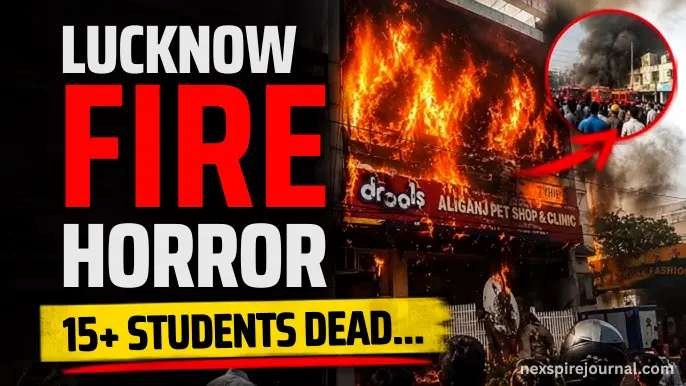

A normal Monday afternoon in Lucknow (India) turned into one of the city’s darkest days. A fire tore through a coaching centre in the Aliganj area, and within a short time, the building was filled with smoke, panic, and screams. By the time firefighters brought the flames under control, at least 15 people had died. Most of them were young students, many in their teens and twenties, who had come to the coaching centre to chase their dream of clearing competitive exams.
The Lucknow coaching centre fire has shaken the entire country. It has reopened a painful conversation that India has had many times before — about how safe our coaching institutes and commercial buildings really are. This article looks closely at what happened during the Lucknow fire incident, how the rescue operation unfolded, why the death toll was so high, and what this tragedy teaches us about fire safety in educational spaces.
What Happened?
The fire broke out on Monday afternoon in a building on Usha Mehta Marg in Lucknow’s Aliganj area, where a coaching centre operated alongside other businesses in a commercial complex. Reports said the blaze spread fast, trapping people inside and forcing some students to jump from the first floor to escape. Fire engines rushed to the spot, and the flames were eventually brought under control after a prolonged operation. .
According to early reports, the fire is believed to have started in the building’s central air conditioning duct system. Once it caught, the flames and smoke spread with frightening speed, moving through the AC ducts and filling classrooms with thick, toxic smoke within minutes. Students sitting in lecture halls had almost no warning before the air around them turned unbreathable.
As the smoke thickened, panic spread through the upper floors. Many students realised they had nowhere to run. Some accounts describe a group of three or four children locking themselves inside a washroom, hoping it would protect them from the smoke. Others tried to escape through windows. Eyewitnesses said several students jumped from the first floor in a desperate attempt to survive, and a few suffered serious injuries from the fall.
Within a short time, word of the Lucknow fire incident spread through the neighbourhood and then across the city. Worried parents and relatives rushed to the site, many of them not even sure if their children were inside at the time.
The immediate impact was severe. At least 24 people were taken to hospital, and 15 were declared dead, while several others were injured. Witness accounts described panic inside the building, shattered windows, and desperate attempts to get out through whatever opening people could find.
Rescue and Emergency Response
Emergency teams, including several fire tenders, quickly arrived at the building and worked to control the fire and locate trapped individuals. Officials stated that 14 fire tenders and a hydraulic platform vehicle were deployed to assist teams battling the smoke and heat inside the building. The speed of the fire and the number of people inside made rescue efforts difficult.
Officials also sent the injured to hospitals for treatment while teams checked the site to ensure no one was trapped. Some students managed to escape by jumping from the building, and videos shared from the scene showed people facing danger while trying to get out. The rescue operation ended only after officials confirmed the completion of the search operation.
The emergency teams’ prompt action was commendable, even though the conditions inside the building made the task extremely difficult. Fourteen fire engines, including a hydraulic platform vehicle, were dispatched to the scene. Police and district administration officials also arrived quickly to manage the crowd and assist in the rescue efforts.
One of the biggest challenges for firefighters was reaching those trapped inside. Thick smoke had virtually eliminated visibility, and the building’s layout made it difficult to enter through the main entrance. In response, fire brigade teams created a second entry by breaking through the second-floor wall of a nearby house. Exhaust fans were brought in to clear the smoke so rescue teams could see and breathe easily.
A careful room-by-room search followed. Every room, including the washrooms, had to be checked individually, as many students were believed to be hiding in closed spaces to escape the smoke. Uttar Pradesh Deputy Chief Minister Brajesh Pathak personally visited the scene to monitor the operation, later telling reporters that the priority was to rescue every child inside.
Some students managed to escape with injuries, mostly from jumping or smoke inhalation, and were taken to King George’s Medical University (KGMU) in Lucknow for treatment. Sadly, many others did not receive help in time.
Why Were So Many Lives Lost?
This is the question that has troubled the entire city, and the answer points to a combination of failures rather than a single cause.
The most serious factor was the apparent lack of emergency exits. Reports following the Lucknow coaching fire suggest that the building had no proper emergency exit routes and no real ventilation system designed for a crisis like this. When a fire breaks out in a building with only one way in and out, students and staff on the upper floors are left with very few options if that path gets blocked by smoke or flames.
Overcrowding made things worse. The building was being used well beyond what a typical coaching centre needs — it combined a coaching institute, an animation centre, a gaming zone and shops, all functioning inside the same structure. This kind of mixed and dense use of a building is risky, especially when it was likely never designed to safely hold that many people at once.
Electrical safety lapses have also come under scrutiny. Investigators found that the building’s power connection was sanctioned for 20 kilowatts but was actually drawing more than 34 kilowatts at the time of the fire. This kind of overload puts enormous strain on wiring and can easily trigger a fire, especially in a building where the electrical system had not been properly inspected in years.
Adding to the concern, it has come out that a no-objection certificate from the Electrical Safety Directorate, issued when the connection was first approved years ago, was never renewed. Had it been renewed, an inspection might have caught the very problems that are now being blamed for the disaster.
There are also troubling questions about how the building came to exist in its current form at all. Reports suggest that the Lucknow Development Authority had issued a demolition order for illegal construction on this very plot back in 2016, an order that was withdrawn just two months later. That detail has added a layer of public anger to the grief, since it suggests the warning signs were there years before the fire ever broke out.
Investigation and Official Response
Chief Minister Yogi Adityanath has ordered a high-level inquiry into the Lucknow fire accident, and a two-member Special Investigation Team has been formed to dig into exactly what went wrong. The investigation is expected to look at how the fire started, whether the building’s construction and electrical systems followed the rules, and which officials, past or present, may have failed in their duty.
Deputy CM Brajesh Pathak has confirmed that officials are examining the building’s history closely, including the electrical connection records and the construction approvals dating back more than two decades. The state government has also directed officials to inspect similar buildings across the city that house coaching centres, to check for the same kind of safety gaps before another tragedy can happen.
President Droupadi Murmu and several political leaders, including Congress leader Rahul Gandhi, have publicly expressed their condolences over the loss of life, calling the incident deeply painful for the nation.
Impact on Students and Families
Behind every number reported in the news is a young person who had a name, a family, and a future they were working hard to build. Many of the victims had moved to Lucknow from smaller towns and villages, often living away from their parents for the first time, with hopes of becoming doctors, engineers, or civil servants.
Outside the building on the day of the fire, family members waited in anguish, some not knowing whether their child had made it out safely. For those whose loved ones did not survive, the grief is made heavier by the knowledge that this was a place meant to help their children build a future, not lose their lives.
The coaching centre community in Lucknow, including teachers, classmates, and the wider student network in the city, has been left in shock. For students who survived but witnessed the horror first-hand, the emotional scars are likely to last long after the physical injuries heal.
Fire Safety in Educational Buildings
This tragedy puts a spotlight on something that is often overlooked until disaster strikes: fire safety in buildings where students spend hours every day.
A safe building needs more than one way out. If smoke or fire blocks a single exit, everyone inside can be trapped within minutes. Working fire alarms give people early warning, often the difference between escaping safely and being caught off guard. Regular fire drills help students and staff know exactly what to do, rather than freezing in panic when something actually goes wrong.
Electrical systems also need routine checks. A building drawing far more power than it was approved for, as seems to have happened in Aliganj, is a warning sign that should never be ignored. Periodic safety inspections, carried out properly and not just on paper, can catch these problems long before they turn deadly.
None of these measures are expensive or complicated. What this tragedy shows is that the cost of skipping them can be measured in human lives.
Lessons and Key Takeaways
For coaching centres and commercial building owners, the lesson is straightforward: buildings used by large numbers of students need to meet fire safety standards, not just business convenience. This means clear and multiple emergency exits, functioning fire equipment, and electrical systems that match the building’s actual usage.
For local authorities, the takeaway is about consistent enforcement. A no-objection certificate that is issued once and never renewed offers little real protection. Demolition orders that get quietly withdrawn without explanation deserve closer scrutiny, not less.
For students and parents, it is worth asking simple questions before joining any coaching centre — how many exits does the building have, is there a fire alarm system, and has the building been inspected recently. These are not awkward questions to ask; they are reasonable ones.
For the wider coaching centre industry, especially in cities like Lucknow that attract thousands of students every year, this is a moment to treat safety as seriously as academic results.
The Lucknow coaching centre fire is a tragedy that did not need to happen. A building without proper emergency exits, an electrical system running far beyond its limit, and years of overlooked warnings combined to take at least 15 young lives in a matter of minutes. The students who died had travelled to Lucknow with hope, not fear, never imagining that the place meant to shape their future would become the site of their final moments.
As investigations continue and the city searches for accountability, the most meaningful response would be real change — buildings that are actually inspected, rules that are actually enforced, and a coaching industry that treats student safety as non-negotiable. Lucknow’s grief should not fade into another forgotten headline. It deserves to become the reason such a tragedy never repeats itself.