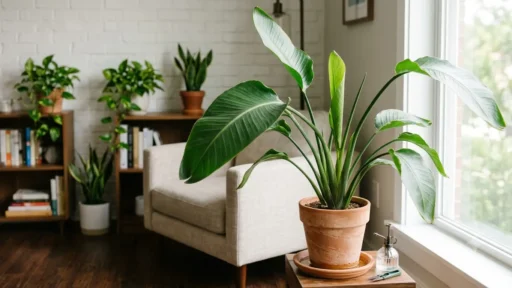
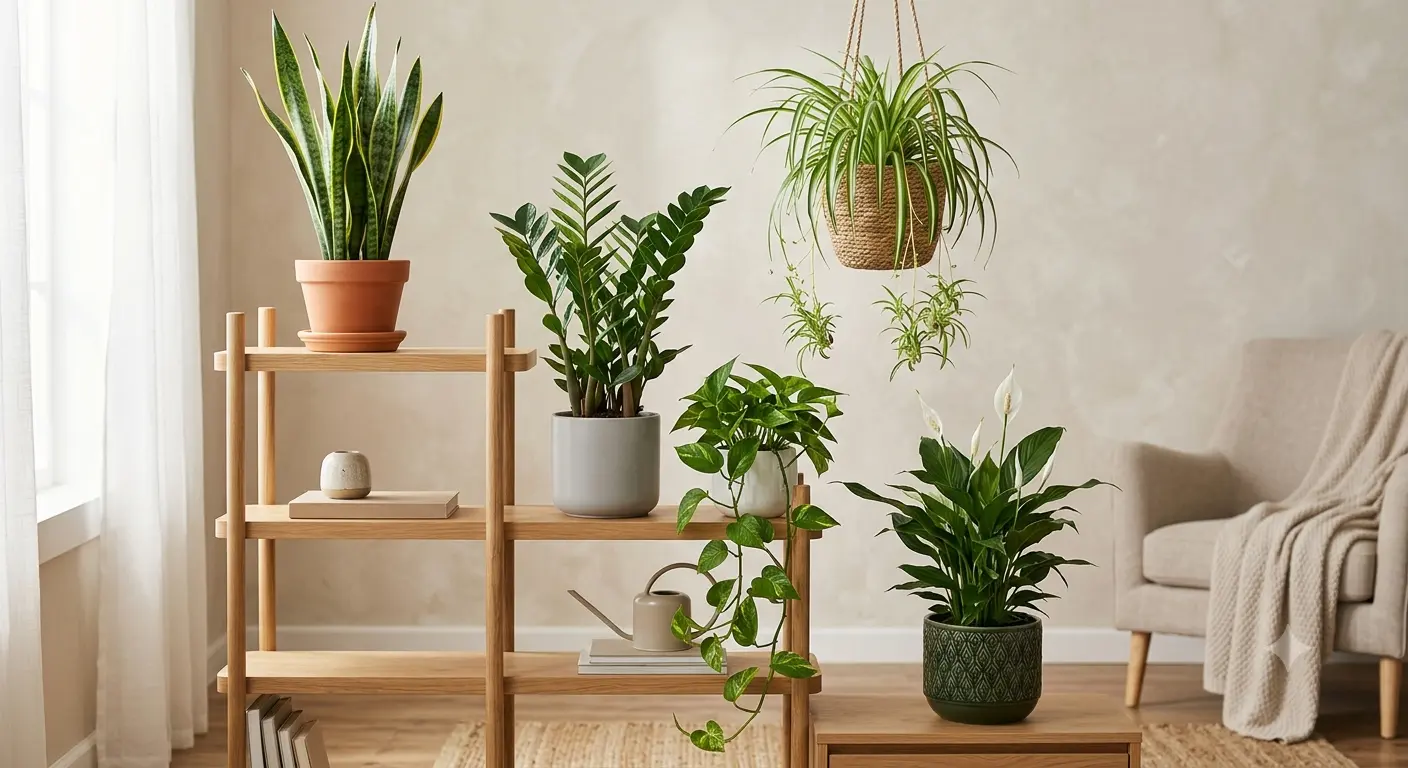

I’ve started noticing the same plant showing up in every “10 plants that will save your life” listicle. Since it’s always the same five or six names rearranged in a different order, I’ve started calling it “the rotation” in my head. Snake plant, pothos, peace lily, repeat. Every few months I’ll open a new article promising cleaner air and a calmer mind, and there’s the rotation again, photographed on the same rustic wooden shelf.
Whenever I see one of these lists, the pattern is usually the same. Someone cites the NASA Clean Air Study from 1989, lists the same handful of species, and moves on without ever mentioning that the study was conducted in a sealed chamber with a single potted plant and no ventilation — nothing like an actual living room with doors, windows, and an HVAC system running.
“Plants are basically air filters with roots,” one caption told me. Which is true, sort of, the way saying humans are basically fish with legs is true. Technically there’s a lineage. Practically, you’d want more context before betting your lungs on it.
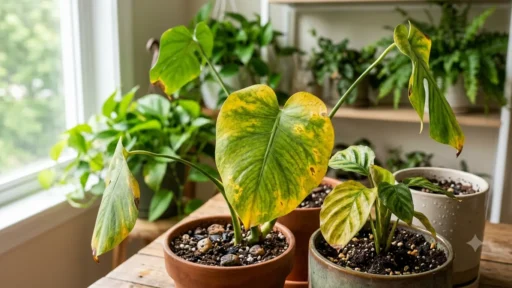
I’ve been keeping plants alive — and, more honestly, killing a fair number of them — for about eight years now. My first apartment had exactly one window that faced a brick wall, and I still managed to keep a pothos alive on nothing but stubbornness and neglect. That’s the plant that taught me something the listicles skip over: the “low-maintenance” label isn’t really about the plant tolerating you. It’s about the plant tolerating the version of you that forgets to water it for three weeks straight, then panics and waters it four days in a row to compensate.
So here’s my actual rotation. Not the Pinterest one. The one that’s survived my apartment, my parents’ place, and one disastrous college dorm with a radiator directly underneath the windowsill.
Snake Plant (Dracaena trifasciata)
This is the plant I recommend to people who tell me, unprompted, that they “kill everything.” Snake plants store water in their thick, upright leaves, which means they’d honestly prefer you forget about them for two weeks rather than fuss over them. Mine sits in a corner that gets maybe an hour of indirect light a day and it’s outlived three different apartments.
It was one of the six plants in that original NASA study, tested for removing formaldehyde and benzene from a sealed chamber. Whether it’s doing meaningful work in your actual bedroom is a fair question — one plant in a 300-square-foot room isn’t running an industrial air scrubber. But it’s also genuinely one of the easiest plants alive to keep upright, and that counts for something on its own.
Pothos (Epipremnum aureum)
The plant that started this whole habit for me. Pothos will grow in a jar of tap water on a windowsill, in a hanging basket in a dim hallway, or trailing off a bookshelf you haven’t dusted since spring. It tells you it’s thirsty by going a little limp, then perks back up within an hour of watering — which is more forgiving feedback than most living things offer.
It was also part of the original NASA lineup for volatile organic compound removal. I won’t oversell that; again, one lab study from decades ago isn’t gospel. But between the resilience and the fact that it roots in water without any real effort, it’s the plant I hand to people who’ve never owned one before.
ZZ Plant (Zamioculcas zamiifolia)
If pothos is forgiving, the ZZ plant is borderline indestructible. It grows from thick rhizomes that store water like a camel stores fat, so overwatering is a bigger risk than underwatering — a rare inversion for houseplants. Mine gets almost no direct sun and I water it maybe once every three weeks. It doesn’t seem to notice or care.
A 2014 study out of the University of Georgia found ZZ plants had some capacity to remove volatile organic compounds from air. It’s worth noting this, and worth not overstating it — no houseplant is going to outperform a decent air purifier or opening a window. What the ZZ plant will do reliably is survive an office with fluorescent lighting and zero natural sun, which is its own kind of miracle.
Spider Plant (Chlorophytum comosum)
I have a soft spot for spider plants because mine came from a cutting my grandmother grew for probably twenty years before I ever showed interest in plants. They tolerate a wide range of light, bounce back fast from missed waterings, and produce little plantlets — “spiderettes” — that you can snip off and root in water to give away or start new pots. It’s the plant equivalent of paying it forward.
It also showed up in the NASA study for its ability to process formaldehyde in that sealed-chamber setting. I bring this up every time not because I think it makes these plants magic, but because I think it’s the honest, slightly less exciting truth that gets lost whenever someone reduces a decades-old lab experiment into a tidy Instagram caption.
Peace Lily (Spathiphyllum)
The dramatic one of the group. Peace lilies droop theatrically the second they’re thirsty, which sounds like a flaw until you realize it’s actually the most useful trait a low-maintenance plant can have — it tells you exactly when it needs water instead of quietly dying while looking fine. Give it a drink and it’s upright again within a few hours.
It prefers low to medium indirect light and was another of the original NASA test subjects. One caveat worth repeating here since it gets left out constantly: peace lilies are toxic to cats and dogs if chewed on. I learned this only because a friend’s cat took an interest in hers, and the emergency vet bill was a far more memorable lesson than anything I’d read online.
Areca Palm (Dypsis lutescens)
The plant I recommend to people who want their space to actually look like a jungle corner, not just have “a plant” in it. Areca palms are bushier and more of a commitment size-wise, but they’re genuinely tolerant of average indoor humidity and don’t demand much beyond bright, indirect light and consistent — not frequent — watering.
They’re often cited for their transpiration rate, meaning they release a fair amount of moisture into the air, which can help in especially dry rooms during winter heating season. That’s a real, observable effect, distinct from and honestly more noticeable day-to-day than any formaldehyde-scrubbing claim.
What I’ve actually learned from eight years of this
Here’s the part the listicles never say out loud: the air quality benefit of a houseplant is real but modest, and it is not a substitute for ventilation, an air purifier, or just opening a window. The NASA study everyone quotes was testing sealed chambers, not living rooms with doors that open and close fifteen times a day. Nobody’s lungs were saved by a single snake plant in the corner of a studio apartment. Mine included.
What these plants actually gave me, reliably, over eight years of forgetting to water things and traveling for weeks at a time, was something quieter. A living thing that didn’t punish me for being inconsistent. A green corner in an apartment that otherwise had none. If cleaner air happens alongside that, I’ll take it — I just won’t pretend it’s the whole reason I keep buying more pots.
FAQ Block:
Do indoor plants really purify the air?
To a modest degree. The often-cited 1989 NASA Clean Air Study found certain plants could remove volatile organic compounds like formaldehyde and benzene in a sealed lab chamber. In a typical home with normal ventilation, the effect is real but far smaller than what’s implied in most articles — plants complement good ventilation and air purifiers rather than replacing them.
What is the easiest air-purifying plant to keep alive?
Pothos and the ZZ plant are widely considered the most forgiving. Both tolerate low light, irregular watering, and general neglect better than most houseplants.
Are any of these plants toxic to pets?
Yes. Peace lilies and pothos are both toxic to cats and dogs if ingested. Snake plants and ZZ plants are also mildly toxic. Spider plants are generally considered non-toxic and are one of the safer choices for pet-owning households.
How often should I water low-maintenance indoor plants?
Most of the plants listed here prefer to dry out between waterings — roughly every 1 to 3 weeks depending on light and humidity. Overwatering is a more common cause of death than underwatering for nearly all of them.