
I’ve covered a lot of “most wanted” stories over the years, and there’s a pattern to them that you stop noticing until you’ve watched it play out a dozen times. The reward number goes up, the rhetoric gets sharper, and somewhere in the fine print, the story gets messier than the headline lets on. I sat down to write a clean explainer on why Washington has a $25 million bounty on Diosdado Cabello’s head. I did not end up writing a clean explainer. The deeper I got into this one, the more it turned into a story about how a wanted man became, briefly, someone the same government photographed itself standing next to.
Let’s start with the number, because that’s the part everyone asks about first.
The $25 Million Question
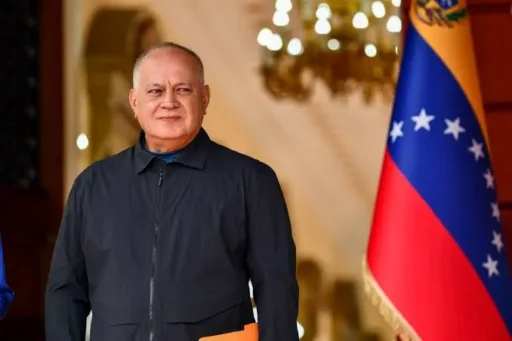
The US government is offering up to $25 million for information leading to the capture and/or conviction of Diosdado Cabello Rondón, currently Venezuela’s interior minister and widely regarded as the second-most powerful figure to come out of the chavista movement. That figure didn’t appear out of nowhere. Back in March 2020, Cabello was formally indicted in a federal court in New York’s Southern District on charges of conspiracy to commit narco-terrorism, conspiracy to import cocaine into the United States, and firearms-related offenses. The original bounty on him at that time was $10 million, announced alongside a much larger $15 million offer for Nicolás Maduro himself.’
Then, in January 2025, the number jumped. The US government raised the reward for information leading to Cabello’s capture and conviction to $25 million, putting him in the same financial bracket as some of the most notorious terror figures the State Department has ever chased.
According to the indictment, Cabello is accused of coordinating the transport and distribution of massive cocaine shipments, providing armed protection for those shipments, obstructing judicial investigations, and helping supply military-grade weapons — including machine guns, ammunition, and explosives — to the FARC, Colombia’s designated terrorist organization. That’s the “Cartel de los Soles” allegation in a nutshell: not a street-level trafficking case, but a claim that senior Venezuelan officials ran a state-embedded narco-terrorism operation for decades.’
I’ll be honest, when I first read the indictment language, I expected something vaguer. It isn’t. It’s specific, and it’s aged into exactly the kind of case the US eventually used as leverage.
Then Maduro Fell, and Cabello Didn’t Disappear
Here’s the plot twist that most reward stories don’t get: the guy at the top of the list is still walking around in public.
On January 3, 2026, US forces captured Nicolás Maduro, ending his presidency. In the aftermath, Delcy Rodríguez, previously vice president, was sworn in as president, and Diosdado Cabello — the interior and justice minister — was present at the ceremony. Rather than fleeing, being arrested, or vanishing into hiding, Cabello kept his cabinet post under the interim government. Washington subsequently placed him at the very top of its reward list, positioning him as its primary target and keeping active narco-trafficking and terrorism charges against Venezuela’s remaining leadership.
That’s the part of this story I find genuinely strange as a reporter. Usually a $25 million reward means someone is hiding in a jungle or a friendly third country, communicating through intermediaries. Cabello has done the opposite. He showed up. He kept his ministry. He kept talking.
The Photos That Complicated Everything
This is where the story stopped being a straightforward “here’s why the reward exists” piece and started being about the gap between policy and practice.
In late June 2026, Venezuela was hit by devastating earthquakes — magnitude 7.2 and 7.5 — that killed thousands and left many more missing. During the humanitarian response that followed, photographs surfaced showing John Barrett, the US Embassy’s chargé d’affaires in Caracas, standing alongside Cabello.
Other images showed him with a US general, Francis Donovan, taken during the same relief operations. For a man the Justice Department has labeled a narco-terrorist since 2020, and whom the Treasury has sanctioned since 2018, that’s not a small optics problem.
Asked directly by a journalist whether the $25 million reward for Cabello was still active, Barrett declined to give a clear answer. Not a denial. Not a confirmation. Just a diplomat’s version of a shrug in front of a camera, which is its own kind of answer if you’ve covered enough of these briefings.
Officially, nothing has changed. The $25 million reward remains formally in place, the New York indictment hasn’t been withdrawn, and the Treasury Department’s sanctions are still active. Secretary of State Marco Rubio reaffirmed that position to Congress as recently as May 2026. But formal policy and functional behavior are drifting apart, and that gap is the real story here, not the dollar figure.
Part of why that gap exists is practical, not ideological. Cabello controls Venezuela’s security apparatus as interior minister, which made him an unavoidable operational counterpart for coordinating access to earthquake-affected zones. You can’t run a humanitarian corridor through a country without talking to the person who commands its police and military checkpoints, wanted poster or not.
Reports from January 2026 also indicate the US held quiet, direct talks with Cabello months before Maduro’s capture, pressing him not to deploy his colectivo militias or security forces against the opposition. So there’s a version of this where the reward was always somewhat theatrical — a pressure tool, not a literal capture order — running in parallel with a back channel that’s been open for longer than most people realized.
Who Cabello Actually Is, If You’ve Never Covered Venezuela Before
If you’re coming to this story fresh, a little background helps.
Cabello isn’t a cartel enforcer who stumbled into politics. He’s a former army captain who has loomed over Venezuelan public life for more than two decades, someone opponents fear and loyalists cheer, known for a sharp tongue and a wicked sense of humor even in hostile press conferences.
He met Hugo Chávez in the military and rode the Bolivarian revolution from its earliest days, never once challenging Chávez or Maduro for the top job but always occupying the room next to it. When Chávez died in 2013, Cabello — then president of the National Assembly — was briefly positioned to take over the presidency temporarily, a role that ultimately went to Maduro instead.
He’s probably best known outside Venezuela for one specific creation. Cabello set up the “colectivos,” armed, motorbike-riding militias that intimidate government opponents — a force the government has limited real control over, according to a former US diplomat who described them as ideologically committed enforcers that can be deployed onto the streets on short notice. His supporters call them a bulwark against crime. His critics call them exactly what they sound like.
He was born in 1963 in El Furrial, a rural town in eastern Monagas state, and he’s married with children. His legal troubles predate the 2020 indictment, too, going back to a 2014 Miami lawsuit filed by the Human Rights Foundation alleging he’d taken massive bribes from a Venezuelan engineering firm.
Is He Actually Going to Turn Himself In?
This is the freshest thread in the story, and I want to flag it as exactly that: a claim, not a confirmed fact.
On July 10, 2026, Jesús Romero, a former US naval intelligence officer, said in a video posted to social media that Cabello — described as the regime’s number two — is planning to surrender to US justice, and claimed to know the “exact reasons” behind that decision.
Security analyst Fernando Vaccotti, discussing the claim on NTN24’s Club de Prensa, argued Cabello has had ample time since Maduro’s January 3 capture to plan his own exit, and that unable to flee Venezuela outright, he may have restarted negotiations that were already underway before Maduro fell.
I want to be careful here, because “unnamed intelligence source says high-profile surrender is coming” is a genre unto itself in Venezuela coverage, and it doesn’t always pan out. But it lines up with what we already know: the quiet pre-capture talks, the fact that Cabello didn’t flee when he had the chance, and a US administration that seems more interested in negotiated outcomes than a raid.
So Why Is the Reward Still There?
Here’s my honest read, as someone who’s spent a career trying to separate policy theater from policy substance: the reward accomplishes something whether or not anyone ever collects it. Rewards like this function as political and deterrent tools as much as literal bounty offers — the Bin Laden case is the standard example, where the US later argued the reward was never actually paid out because his location came from electronic intelligence, not a tipster.
Keeping the Cabello reward technically active preserves leverage. Quietly working with him on the ground preserves stability during a humanitarian crisis. Those two things can both be true at once, uncomfortable as that is.
The open question, as one outlet put it, is how long Washington can maintain that official posture while its own generals and diplomats keep showing up in photos next to the man it says it wants captured. I don’t have a tidy answer to that, and I’m suspicious of anyone who claims they do right now.
What I can tell you is that the $25 million is still on the board, the indictment is still open, and the man it’s written for is still, as of this week, sitting in a government office in Caracas instead of a courtroom in New York. Whether that changes soon, or whether it just quietly stays this way for another six months, is the part of this story nobody outside a very small circle actually knows yet.
You May Also Read: