
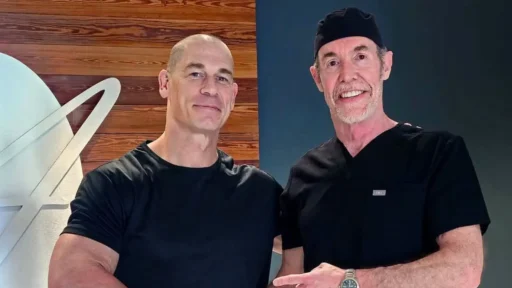


John Cena has spent years making headlines for slams, championships, and blockbuster movie roles. This week, he’s trending for something far more personal — a photo of his completely shaved head.
On June 29, 2026, the WWE legend shared a picture of himself smiling and shaking hands with his doctor, and within hours, the image was everywhere. Fans didn’t scroll past it. They stopped, stared, and started talking. Some were surprised. Some were supportive. Almost everyone had something to say about John Cena’s bald look.
But here’s the twist: this wasn’t a bad hair day. It was a carefully planned step in his hair transplant journey, and Cena wanted the world to see it.
Why This Photo Is Trending
The photo shows Cena with a fully shaved head, standing beside Dr. Ken Anderson of the Anderson Center for Hair in Atlanta. In his caption, Cena explained that he was starting “Round 2” of his FUE, or Follicular Unit Extraction, treatment.
“This time I went all in for best possible results,” he wrote, thanking Dr. Anderson and his team for “accompanying me on this journey.”
That single post did what most celebrity announcements dream of doing — it sparked a genuine conversation. Not just about Cena, but about hair loss itself, a topic millions of men quietly deal with but rarely discuss in public.
This isn’t Cena’s first time opening up about it, either. He first went public with his hair transplant story back in 2024, revealing that he’d undergone the procedure after years of good-natured (and sometimes not-so-good-natured) jokes from wrestling fans about his thinning hairline. He’s said the decision “completely changed the course of my life,” giving him more flexibility as an actor to play different characters with different looks.
What Exactly Is a Hair Transplant?
For anyone unfamiliar with the process, a hair transplant might sound intimidating. In reality, it’s a well-established, minimally invasive procedure that’s been refined for decades.
In simple terms, a hair transplant moves hair follicles from an area where hair is still growing thick — usually the back or sides of the head — to areas where hair has thinned or disappeared. The idea is straightforward: your body already knows how to grow hair in certain spots, so doctors relocate that growing power to where it’s needed most.
There are two common techniques people usually hear about:
FUE (Follicular Unit Extraction) — This is the method Cena is using. Individual hair follicles are removed one at a time from the donor area and then carefully implanted into the thinning region. It’s more time-consuming, but it leaves minimal scarring and a faster recovery, which is part of why it’s become the go-to choice for many patients, including public figures who can’t disappear from view for weeks.
FUT (Follicular Unit Transplantation) — In this older method, a strip of scalp is removed, and follicles are separated from it before being transplanted. It can cover more area in a single session but usually involves a more noticeable scar and longer healing time.
Neither method “grows new hair” out of nowhere. They redistribute what a person already has, which is why doctors always assess how much healthy donor hair someone has before recommending the procedure.
Why Celebrities Choose Hair Transplants
Hair loss doesn’t discriminate. It affects athletes, actors, business leaders, and everyday people alike. But when you’re constantly in front of cameras, the way your hair looks can genuinely affect your career opportunities, which is part of what Cena has spoken about publicly.
For celebrities specifically, hair transplants have become far more common and far less secretive than they used to be. As awareness has grown, so has honesty. Public figures are increasingly choosing to document their experiences rather than hide them, which helps normalize a procedure that used to carry a lot of quiet stigma.
What Medical Experts Say
According to widely respected sources like the American Academy of Dermatology and the Mayo Clinic, hair transplant surgery is generally considered safe when performed by a qualified, board-certified professional. Dermatology experts note that the procedure works best for people experiencing pattern hair loss, and that results typically take several months to become fully visible, since transplanted follicles go through a shedding phase before new growth appears.
Medical sources also emphasize that recovery is usually quicker with FUE compaSocial media lit up almost instantly. Some fans jokingly nicknamed him “Stone Cold Cena,” pointing out the resemblance to fellow WWE legend Steve Austin’s iconic bald look. Others compared his fresh shave to a comic book villain, all in good fun.
Plenty of comments, though, leaned heartfelt rather than humorous. Many fans praised Cena for being open about something so personal, with several noting how refreshing it is to see a global superstar talk candidly about insecurity instead of pretending it doesn’t exist.
That reaction says a lot. It’s not really about hair. It’s about honesty.red to older techniques, though some redness, swelling, or scalp sensitivity in the days following surgery is completely normal. Doctors generally recommend follow-up sessions in some cases, which lines up with what Cena himself is going through with his second round of treatment.
Social media lit up almost instantly. Some fans jokingly nicknamed him “Stone Cold Cena,” pointing out the resemblance to fellow WWE legend Steve Austin’s iconic bald look. Others compared his fresh shave to a comic book villain, all in good fun.
Plenty of comments, though, leaned heartfelt rather than humorous. Many fans praised Cena for being open about something so personal, with several noting how refreshing it is to see a global superstar talk candidly about insecurity instead of pretending it doesn’t exist.
That reaction says a lot. It’s not really about hair. It’s about honesty.
The Human Side of Hair Loss
It’s easy to treat hair loss as a small, cosmetic issue, but for many people, it’s tied to something deeper — confidence. How we look in the mirror often shapes how we feel walking into a room, meeting new people, or stepping in front of a camera.
Cena has said before that hiding his hair loss only made him more self-conscious, and that the jokes from fans, while mostly lighthearted, still stung. Choosing to address it publicly, rather than quietly disappearing for a procedure and reappearing with fuller hair, takes a certain kind of vulnerability that’s rare for someone so used to being seen as invincible.
That vulnerability is likely a big reason this story resonates with so many people who’ve never set foot in a wrestling ring.
Let’s Come to the Point
John Cena’s shaved head photo may have started as a simple social media post, but it’s turned into something bigger: a reminder that hair transplant technology has evolved into a safe, accessible, and increasingly normalized option for people dealing with hair loss.
Modern techniques like FUE have made the process quicker, less invasive, and easier to talk about openly, something Cena is clearly embracing headfirst — literally.
Whether you’re a lifelong WWE fan or just scrolled past his photo out of curiosity, one thing is hard to deny. Cena isn’t just chasing a fuller head of hair. He’s helping change the conversation around one of the most common, and most quietly stressful, experiences so many people share.
This article is intended for general informational purposes. Anyone considering a hair transplant procedure should consult a licensed dermatologist or board-certified hair restoration specialist to discuss their individual situation.