
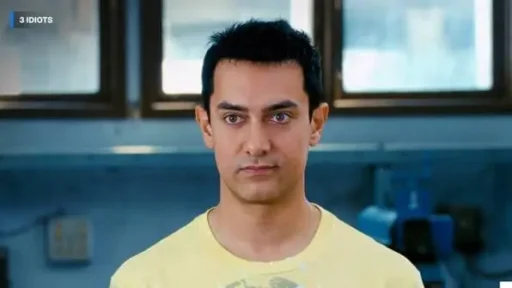

There’s a version of Bollywood stardom built on doing a lot. And there’s Aamir Khan’s version, built almost entirely on doing less — fewer films, longer gaps, and an insistence on getting the script right before a single frame gets shot.
It sounds like a small distinction. It isn’t. It’s the reason a man who’s released barely one film every couple of years has still managed to hold, at various points, the record for the highest-grossing Indian film of all time — five separate times, with five different movies. That’s not luck stacking up. That’s a pattern.
So who is he, actually, beyond the “Mr. Perfectionist” nickname everyone repeats without explaining?
Early Life and Family
Aamir Khan was born on March 14, 1965, in Mumbai, into a family already embedded in Hindi cinema. His father, Tahir Hussain, was a producer, and his uncle, Nasir Hussain, was a major producer-director through the 1970s. Film wasn’t a career choice for young Aamir so much as the family business next door.
He got his first screen appearance at just eight years old, in a small role in his uncle’s 1978 film Yaadon Ki Baaraat. But that early cameo didn’t turn into a childhood acting career — he stepped away from the screen for years afterward, working instead as an assistant director on a few of his uncle’s projects, quietly learning the craft from behind the camera before ever stepping in front of it as an adult.
Before any of that, though, there was tennis. Aamir competed at the state level in Maharashtra as a young man, seriously enough that acting was, for a while, the backup plan rather than the destination.
The Breakthrough: Qayamat Se Qayamat Tak
Everything changed in 1988. Aamir’s first major leading role came in Qayamat Se Qayamat Tak, a tragic romance opposite Juhi Chawla, directed by his cousin Mansoor Khan. The film was a massive hit, built around a soundtrack people still hum today, and it won Aamir a Filmfare Award for Best Male Debut.
It also set the template for how audiences would see him: the earnest, boy-next-door lead, believable in a way a lot of his contemporaries weren’t trying to be.
The 1990s: Building a Career, One Hit at a Time
Through the 1990s, Aamir built a steady run of commercially successful films — Dil (1990), Jo Jeeta Wohi Sikandar (1992), Hum Hain Rahi Pyar Ke (1993), and Raja Hindustani (1996) among them. This wasn’t the era of his biggest artistic risks, but it was the era that made him bankable, which mattered enormously for what came next.
2001 Onward: Lagaan and the Rise of Aamir Khan Productions
In 1999, Aamir launched his own production company, Aamir Khan Productions. Its first release changed his career’s trajectory entirely: Lagaan (2001), a period sports drama about villagers challenging British colonial officers to a cricket match, earned an Academy Award nomination for Best Foreign Language Film and became a defining film of modern Hindi cinema.
The same year, he starred in Dil Chahta Hai, a coming-of-age drama that’s still cited as one of the films that reshaped how Bollywood told stories about friendship and youth.
In 2007, Aamir made his directorial debut with Taare Zameen Par, a drama about a child with dyslexia, in which he also played a supporting role. It struck a chord well beyond typical box office numbers — the kind of film that gets recommended by teachers, not just critics.
The Record-Breaking Run
Between 2008 and 2016, Aamir became something close to a one-man box office event. Ghajini (2008), 3 Idiots (2009), Dhoom 3 (2013), PK (2014), and Dangal (2016) each took a turn as the highest-grossing Indian film of all time. Dangal alone crossed roughly ₹2,000 crore worldwide, driven in large part by its enormous success in China — a market Aamir’s films have connected with more consistently than almost any other Indian star’s.
Not every project in this window landed. Thugs of Hindostan (2018) and Laal Singh Chaddha (2022), a Hindi adaptation of Forrest Gump, both underperformed significantly, proving that even a run this strong isn’t immune to a box-office miss.
Beyond Acting: TV, Social Issues, and Production
In 2012, Aamir stepped into television with Satyamev Jayate, a talk show tackling difficult social issues — female infanticide, child sexual abuse, dowry deaths — that reached a scale of public conversation talk shows rarely manage in India. It’s easy to forget how unusual that pivot was for a star of his level at the time.
As a producer, his company has continued backing projects beyond his own acting roles, including newer productions moving into 2026.
The 2025–2026 Comeback
After the disappointment of Laal Singh Chaddha, Aamir’s next lead role, Sitaare Zameen Par (2025), marked a genuine comeback, performing strongly at the box office and reminding audiences why his return was worth waiting for. He also appeared in a cameo in the Tamil action film Coolie (2025) alongside Rajinikanth, and has a production, Happy Patel: Khatarnak Jasoos, releasing in early 2026 with a cameo appearance of his own. Another Aamir Khan Productions film, set against the backdrop of the 1947 Partition, is expected later in 2026.’
Personal Life
Aamir has been married three times. His first marriage, to Reena Dutta, lasted from 1986 to 2002; they have two children, Junaid Khan (an actor) and Ira Khan. His second marriage, to filmmaker Kiran Rao, lasted from 2005 to 2021; they have a son, Azad. In July 2026, Aamir married Bengaluru-based entrepreneur Gauri Spratt.’
The Bigger Picture
What makes Aamir Khan’s career worth studying isn’t just the box-office numbers, though those are genuinely remarkable. It’s the pattern underneath them: a career built on saying no far more often than yes, and treating each film — hit or miss — as worth getting right rather than getting out quickly.