
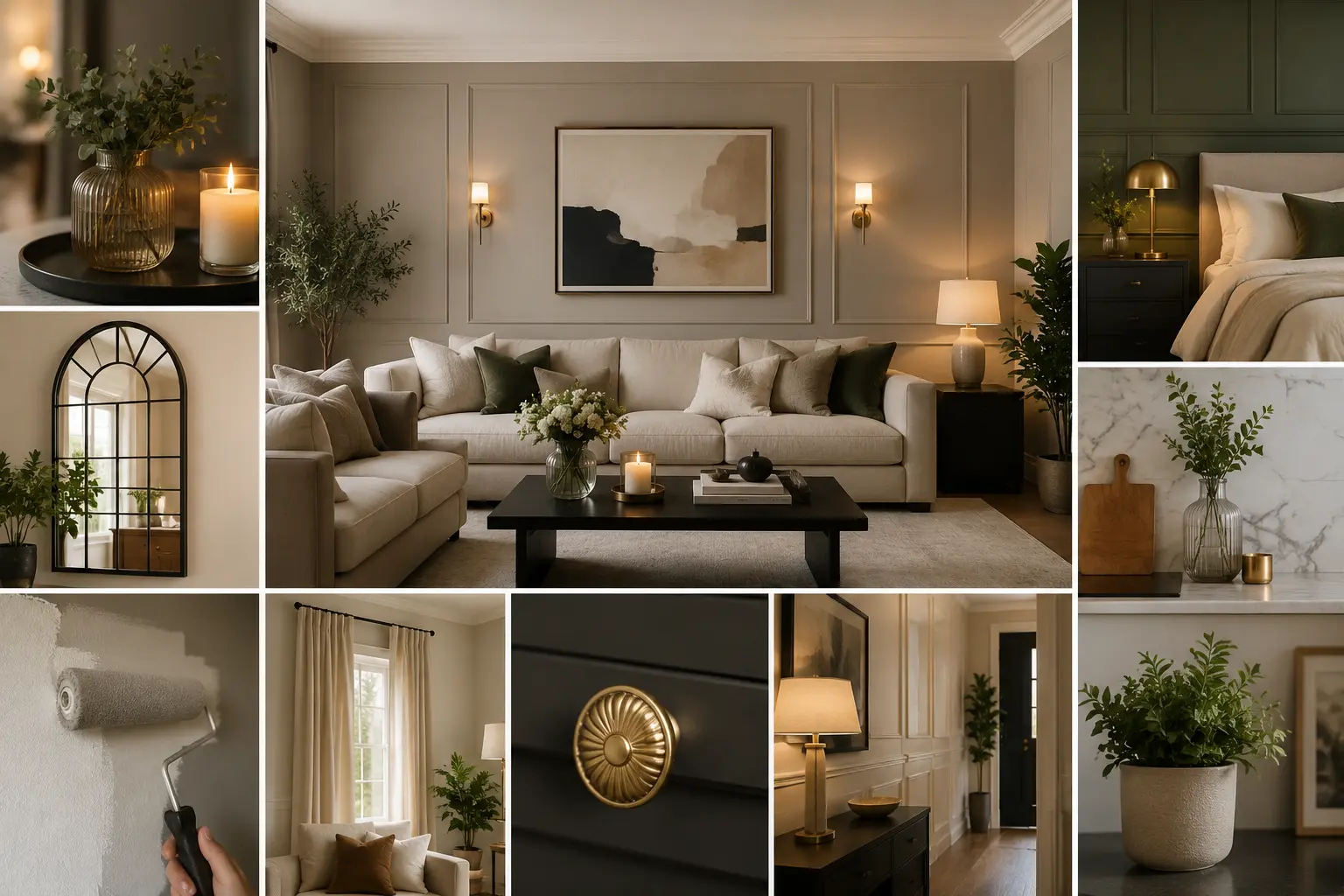

Last spring I spent four hundred dollars on my living room and a friend walked in, looked around, and asked who my interior designer was.
I let her believe it for a solid thirty seconds. It felt good. Then guilt got the better of me, aka I told her the truth: no designer, no loan, no five-figure renovation. Just paint, a few smart swaps, and a refusal to buy anything that looked like it came from a college dorm clearance sale.
That’s the thing nobody tells you about “expensive-looking” homes. Expensive and looks expensive are not the same category. One requires money. The other requires attention — to light, to proportion, to the two or three details that quietly signal “someone thought about this room” instead of “someone furnished this room in an afternoon.”
Here’s what actually moved the needle for me, backed by what designers and renovation data consistently point to as well.
Paint Is Still the Highest-ROI Move in the Room
I know. Everyone says this. I said it too, skeptically, until I repainted my trim.
Not the walls — the trim. Baseboards, door frames, window casings. Most rental-grade and builder-grade homes have trim in a flat, slightly off-white that yellows over time. A coat of bright white semi-gloss on trim against a soft, saturated wall color (think deep sage, warm terracotta, or charcoal) creates the kind of contrast that reads as “custom” rather than “landlord special.”
According to the National Association of Realtors’ Remodeling Impact Report, interior painting consistently ranks among the highest cost-recovery projects homeowners undertake, often recovering more than the amount spent. You don’t need designer numbers to know a $50 gallon of paint outperforms a $500 throw pillow.
Budget Tip: Paint one accent wall or all your trim before you touch anything else. It’s the cheapest transformation per square foot, full stop.
Swap Your Lighting Before You Swap Your Furniture
My ceiling fixture, pre-makeover, was a builder-basic flush mount — the kind that looks like it’s apologizing for existing. I replaced it with a $60 semi-flush brass fixture and added two plug-in wall sconces on either side of my couch.
That’s it. That was the single biggest “wait, did you renovate?” trigger of the entire project.
Lighting does something furniture can’t: it changes the quality of a room, not just its contents. Warm-toned bulbs (look for 2700K–3000K) instead of the harsh blue-white of standard builder bulbs alone will make a space feel considered rather than accidental. Layer it — overhead, a lamp, a sconce — and you’re doing what hotels and staged model homes do to make rooms photograph well.
Budget Tip: Replace one central fixture and add at least one lamp at seated eye-level. Warm bulbs everywhere.
Hardware Is Cheap. Hardware Is Also a Cheat Code.
Cabinet knobs, drawer pulls, door handles — these are the jewelry of a house, and they’re criminally overlooked. I changed every kitchen cabinet knob for under $80 and the entire kitchen looked renovated, not just cleaned.
This tracks with what kitchen and bath remodeling data consistently shows: cosmetic updates to cabinetry (refacing, hardware, paint) deliver a large share of a full remodel’s visual impact at a fraction of the cost, since you’re not touching plumbing, layout, or structure — the parts that actually cost money.
Budget move: Matte black or brushed brass hardware, consistent throughout one room. Don’t mix finishes unless you’re doing it on purpose.
Curtains Should Touch the Floor. That’s the Whole Secret.
I used to hang curtains at the top of my window frame because that’s where the rod came pre-installed. Turns out that’s the single fastest way to make a ceiling look short and a room look cheap.
Mount curtain rods four to six inches above the window frame, and let the curtain fall all the way to the floor — not hovering an inch above it, touching it. This one adjustment tricks the eye into reading the ceiling as taller and the window as grander than it is. Interior designers call this an old trick for a reason: it costs nothing but a drill and five minutes, and it’s one of the most reliable “wait, this looks expensive” moves out there.
Budget Tip: Re-mount your existing rods higher. Buy floor-length panels even if it means hemming them yourself.
Declutter Like You’re Selling the House
This one isn’t glamorous, but it’s the free renovation nobody wants to do. Every real estate stager will tell you the same thing: rooms look more expensive with less in them, not more.
Clear surfaces. Fewer, larger objects instead of many small ones. One good vase beats five mediocre knickknacks. This isn’t about minimalism as an aesthetic philosophy — it’s about the fact that visual clutter reads as chaos, and chaos reads as cheap, regardless of how much any individual object cost.
Budget Tip: Remove a third of what’s currently on your shelves and surfaces. Then remove a bit more.
The Real Lesson From My Living Room
None of this required a contractor, a loan, or a weekend of destruction. It required noticing what was actually cheap-looking about the room — flat trim, harsh lighting, mismatched hardware, curtains floating above the floor — and fixing those specific, small things instead of buying more furniture to distract from them.
My friend’s question — “who’s your designer?” — wasn’t really about design. It was about attention. The rooms that look expensive aren’t the rooms with the most money in them. They’re the rooms where somebody looked closely enough to notice what was off, and fixed it.