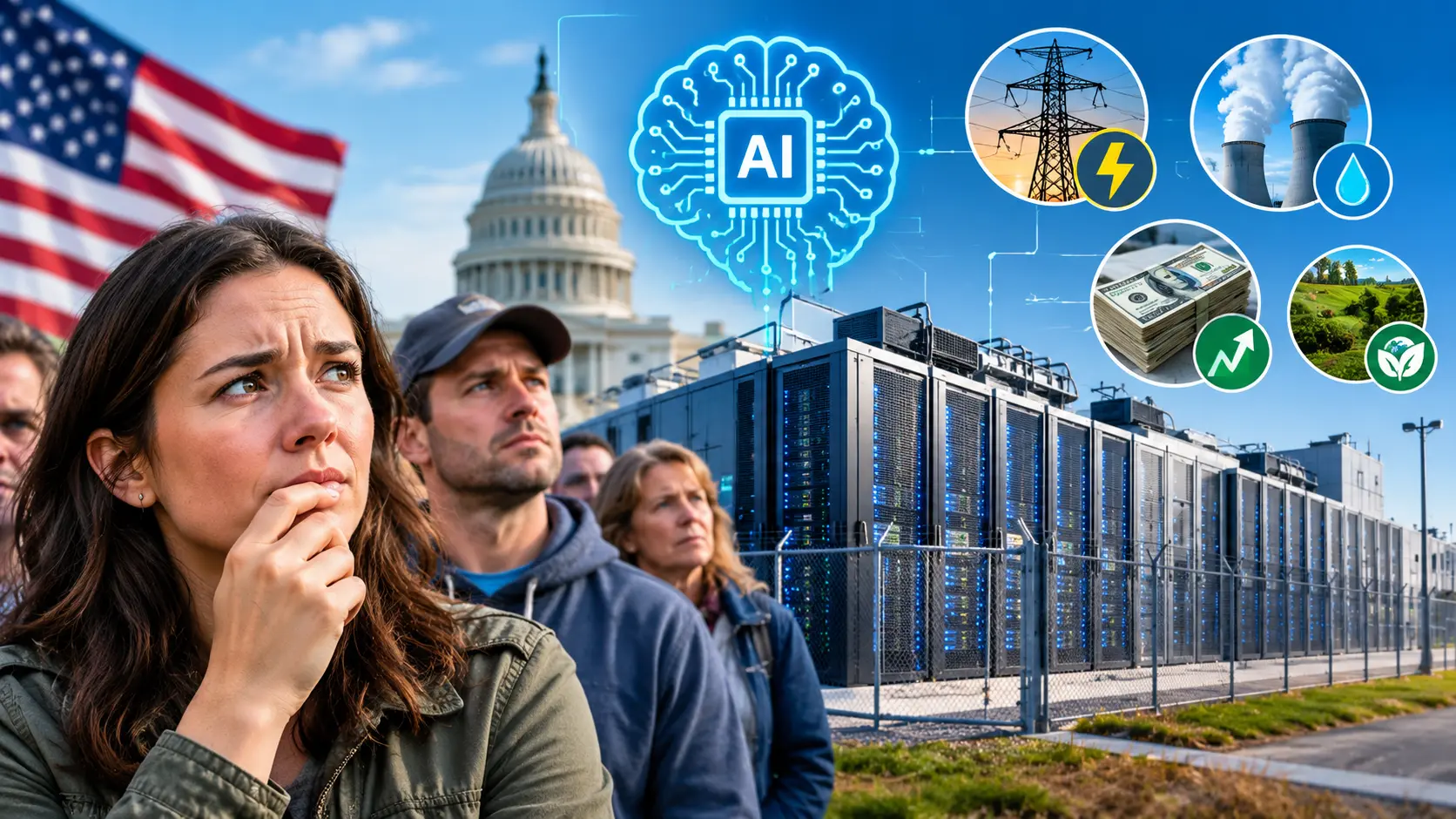

QUICK ANSWER: Most Americans are worried about AI data centers because they push up electricity bills, use huge amounts of water, run noisy day and night, and often don’t bring the jobs that were promised. A 2026 poll found 78% of people are concerned about the environmental impact, and in areas with lots of data centers, electricity prices have jumped by as much as 267% in five years.
What Is an AI Data Center, Anyway?
Think of an AI data center as a huge warehouse filled with state-of-the-art computers. These computers are used to run artificial intelligence applications such as ChatGPT, Google Gemini, Grok, and hundreds of others. Because training and operating AI requires a lot of computing power, the tech industry is building more and more large-scale warehouses to meet the demands of these applications.
The problem with these warehouses is that they consume as much electricity as a small city and require an enormous amount of water to function, to prevent the computers inside from overheating.
Why Are Electricity Bills Going Up Because of AI Data Centers?
Quick answer:A single large data center for artificial intelligence uses as much electricity as 100,000 homes. Such a significant load on the electrical grid can lead to increased electricity costs for all residents since the infrastructure requires upgrades, the costs of which are often passed on to private customers.
Who Pays for the Power Grid Upgrades?
The increase in the number of data centers leads to additional costs for upgrading the electrical grid; significant investments are needed to increase the electrical capacity. The costs of these investments are distributed among all electricity customers in proportion to their share in the electricity produced. Thus, even those residents who will never use AI products will have to cover these costs.
According to a Consumer Reports survey of more than 2,000 adults, 78 percent of them worried that the adoption of new data centers would lead to higher electricity rates in their homes. Residents note that electricity prices in regions with many data centers are already spiking. For example, in five years, prices in such areas have jumped by 267 percent in wholesale trading.
Meanwhile, the representatives of Big Tech insist that they will cover all the costs of electricity on their own. However, the survey data show that the residents do not trust such assurances, especially since they are often presented in the form of rhetoric without specific commitments. According to the survey, consumers want such costs to be regulated contractually.
Will AI Data Centers Run Out of Water?
Quick answer: Yes, this is a real worry. A large data center can use up to five million gallons of water a day to keep its computers cool, and some projections say AI data centers could need 6.4 trillion gallons by 2027.
Computers generate a lot of heat, and water is one of the cheapest ways to cool them down. The problem is that this water often comes straight from the same supply that feeds local taps, farms, and rivers. In drier states, that’s a genuine concern for the future, not just a talking point.
Do AI Data Centers Actually Bring Jobs?
Quick answer: Not as many as promised. Once a data center is built, it usually only needs a small team of technicians to keep it running — construction jobs are temporary, but the facility itself is not a big employer.
This is one of the most common complaints at local town hall meetings. Developers often pitch new data centers as a jobs boost, along with tax breaks to sweeten the deal. But once the building work finishes, the long-term local jobs rarely match the hype. Researchers at Harvard have pointed out that nearby communities don’t even get faster or cheaper access to the AI technology their data center helps to power.
Noise, Pollution, and Everyday Annoyances
If you’ve ever lived near a factory, you know what this is. Data centers host servers that run 24/7, the cooling fans and backed up generators making a constant droning noise. This is the sound that residents of New Jersey are suing a data center operator for, claiming it’s ruining their sleep and lowering their home’s value. Noise ordinances in the state, written long before the advent of data centers, are proving ineffective at muting the machines’ sound.
How Are Americans Fighting Back?
This isn’t a small, quiet issue anymore. It’s become one of the most talked-about local political topics in the country.
- A Gallup poll from March 2026 found 70% of Americans oppose a new AI data center being built in their own neighbourhood.
- Only around 11% of people say they’d actually welcome one nearby, according to a UMass Amherst poll.
- By mid-2026, local opposition had already blocked around $130 billion worth of data center projects across the US.
- Community groups have grown fast — one tracking group counted over 640,000 people actively involved in anti-data center campaigns.
People are showing up to town meetings, signing petitions, and in some cases, even voting out local officials who approved data center deals without public input. Some residents have even forced recall votes against mayors who signed off on these projects.
What Can You Actually Do About It?
You don’t have to feel powerless about this. A few realistic steps:
1. Check your utility bill for any new line items related to grid upgrades or large new customers.
2. Go to local zoning and town hall meetings if a project is proposed near you — this is where most decisions actually get made.
3. Ask your utility regulator whether data center energy costs are being shared fairly, or just passed on to households.
4. Look into energy efficiency or solar options to lower your own bill regardless of what data centers do to local prices.
Frequently Asked Questions
Are AI data centers bad for the environment?
They can be. They use huge amounts of electricity and water, and most of that electricity still comes from fossil fuels in many parts of the country, adding to local pollution and emissions.
Why don’t data centers bring many jobs?
Because running one mostly needs automated systems and a small technical team. The bulk of the jobs are during construction, not after the building opens.
Can I stop a data center being built near me?
Sometimes, yes. Community pushback at zoning and planning meetings has already stopped or delayed tens of billions of dollars’ worth of projects across the country.
Will my electricity bill definitely go up because of data centers?
Not guaranteed, but it’s a real risk in areas with several large data centers, since grid upgrade costs are often shared across all ratepayers.
Are both political parties concerned about this?
Yes. Polling shows worry about data centers crosses party lines, even if the reasons — environment versus cost versus distrust of big tech — differ a little.