
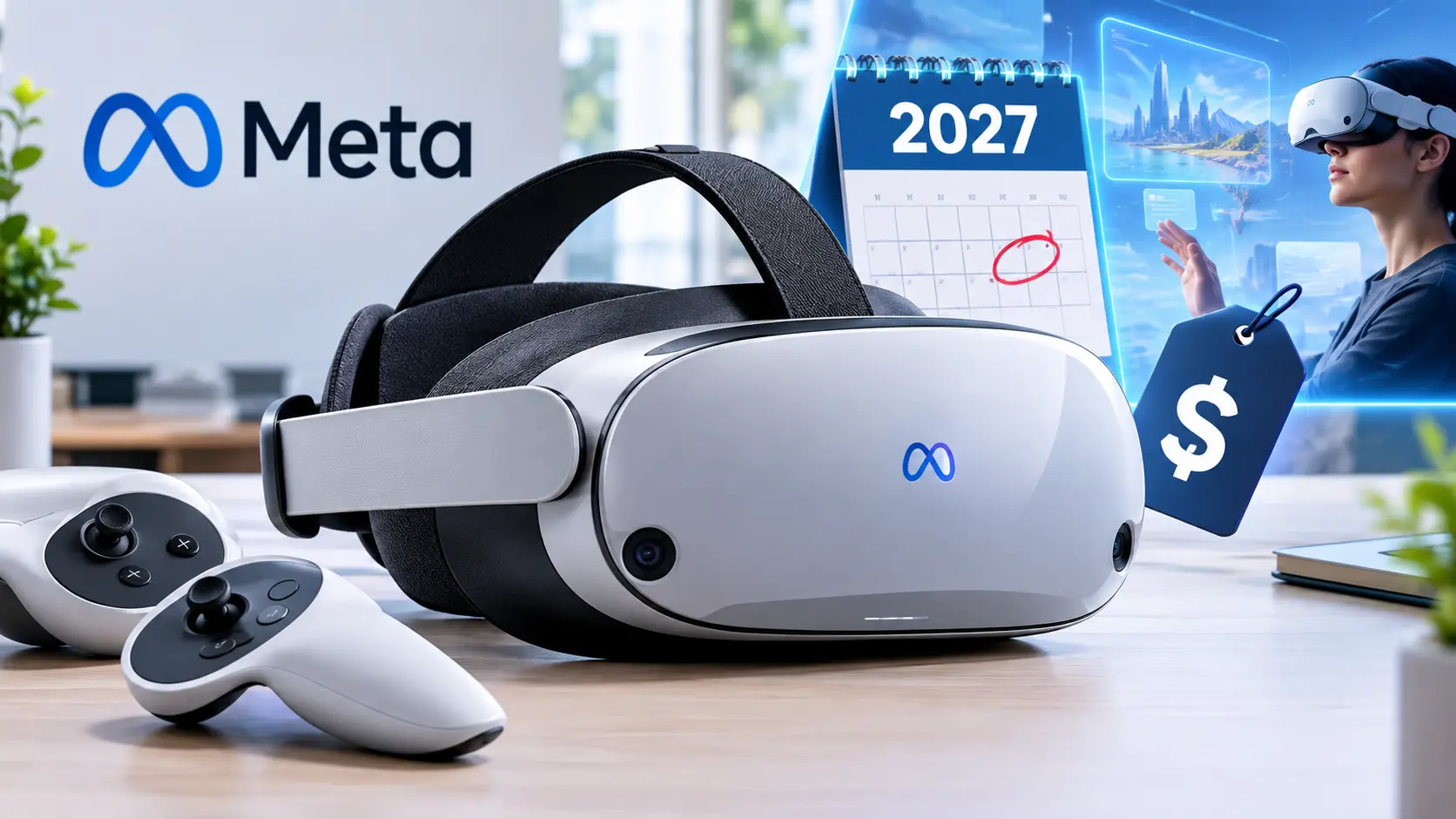

Quick answer: Meta VR Glasses will be available for purchase in the spring of 2027 and cost $1,299.99 in the United States. They were officially unveiled at the event called Meta Connect on 23 September 2026, weigh about 100 grams, and have a separate “puck” for the processor and battery instead of being built directly into the headset itself.
Should I have stopped reading at the first paragraph? I don’t think so because if you continue reading this article, it will explain what you are paying for in detail, justify why it is worth the wait, and compare its value to Apple’s Vision Pro.
What Are Meta VR Glasses, Exactly?
Meta VR Glasses are a new product that Meta is developing to create a lighter, glasses-like virtual reality display. Unlike bulkier, headset-style Quests, these glasses are light and resemble common glasses. The reason behind their lightweight is that all the heavy components such as processor, battery, and a cooling fan have been placed in a small puck-shaped external controller connected to the glasses via a cable.
This allows the glasses to be relatively light, about 100 grams, or one-fifth the weight of a Quest 3, which could make them comfortable even after twenty minutes of continuous use.
Release Date: When Can You Actually Buy Them?
Meta announced that these glasses will be launched in the spring of 2027. It is still unclear when exactly they will be delivered, and Meta has not opened up for pre-orders yet. This means that this product is a “coming soon”, a product that is not available for order yet.
Important note: this is an alternative launch for Meta’s other set of glasses, which was launched right away in October 2026, including Ray-Ban Meta Gen 3 ($449) and Ray-Ban Meta Audio glasses (from $349), and are now shipping. The Meta VR glasses are more premium and later-launching.
Price: What Do You Get for $1,299.99?
At $1,299.99, Meta VR Glasses sit firmly in the premium bracket — more than most Quest headsets, but still cheaper than Apple’s Vision Pro, which launched at $3,499. Here’s what that price gets you:
- 5K micro-OLED displays for sharp, detailed visuals
- Dolby Vision and Dolby Atmos support, plus IMAX Enhanced certification — the first VR device to get that badge
- Snapdragon Reality Elite chipset, roughly equivalent to an XR2 Gen 3, running the same software as Quest 3
- 12GB of RAM and 128GB of storage, with a microSD slot in the puck for extra space
- Eye tracking and hand gesture controls, so you don’t always need controllers
- Up to 3 hours of continuous high-resolution video playback
One catch: controllers aren’t included by default. If you want Touch Plus controllers, you’ll need to buy them separately, though some retail bundles will include them, and Meta says the glasses will work with controllers from an existing Quest 3 or Quest 3S.
Why Meta Built It This Way
For years virtual reality headsets have been problematic in that in order to have a decent display, a battery powerful enough to supply the necessary power, a chip which processes the images and a cooling system which dissipates the heat generated, all fitted on the headset. Meta’s solution to this issue is to divide the headset into two separate units. The second unit being a puck which is kept in the user’s pocket or on a desk. This puck handles all the power hungry tasks required for the headset to function.
Besides the comfort of the user, this approach also allows them to analyze the usage patterns of the product and improve future pucks without having to redesign the entire headset. This shows that they’re thinking about long term VR sessions in a much bigger scale than most of their competitors have been able to do so far.
Meta VR Glasses vs Apple Vision Pro: The Short Version
| Meta VR Glasses | Apple Vision Pro | |
| Price | $1,299.99 | $3,499 |
| Weight (headset) | ~100g | Much heavier, similar external battery pack |
| Release | Spring 2027 | Available now |
| Display | 5K micro-OLED | Micro-OLED |
| Ecosystem | Quest software, Prime Video, YouTube, HBO Max, ESPN, NBA, MLB, and more | visionOS apps |
Meta is clearly positioning this as the more affordable, more comfortable option for people who want to watch films, sports, and TV in an immersive way — plus get some productivity use out of virtual multi-screen setups — without paying Vision Pro money.
What Can You Actually Do With Them?
For years virtual reality headsets have been problematic in that in order to have a decent display, a battery powerful enough to supply the necessary power, a chip which processes the images and a cooling system which dissipates the heat generated, all fitted on the headset. Meta’s solution to this issue is to divide the headset into two separate units. The second unit being a puck which is kept in the user’s pocket or on a desk. This puck handles all the power hungry tasks required for the headset to function.
Besides the comfort of the user, this approach also allows them to analyze the usage patterns of the product and improve future pucks without having to redesign the entire headset. This shows that they’re thinking about long term VR sessions in a much bigger scale than most of their competitors have been able to do so far.
Should You Wait for Them?
However, if you are a Quest 3 owner and a serious VR gamer, there is no need to rush and purchase the new devices right away. If you have struggled with VR sickness or uncomfortable headsets or have kept waiting for the Quest 3 to announce a more accessible price, Meta VR Glasses can be a great compromise between PC VR and standalone headsets. As of now, the release date is still about six months away, so the company might change some specifications and pricing. It would be wise to check the company’s website again around spring of 2027 and see all the improvements before purchasing the glasses.
FAQ
When do Meta VR Glasses come out?
Spring 2027. No exact date has been confirmed yet.
How much do Meta VR Glasses cost?
$1,299.99 in the United States.
Do Meta VR Glasses come with controllers?
No, not by default. Touch Plus controllers are sold separately, though some retail bundles will include them, and existing Quest 3 controllers are compatible.
How much do Meta VR Glasses weigh?
Around 100 grams — about a fifth the weight of the Meta Quest 3.
Are Meta VR Glasses cheaper than Apple Vision Pro?
Yes. At $1,299.99, they cost less than half of the Vision Pro’s $3,499 price tag.
Can you watch Netflix or sports on Meta VR Glasses?
Yes. Confirmed content partners include Prime Video, YouTube, Peacock, HBO Max, and live sport from the NBA, MLB, and ESPN, among others.
Sources
- Bloomberg: Meta Launches $1,299 VR Headset to Rival Apple Vision Pro — https://www.bloomberg.com/news/articles/2026-09-23/meta-launches-1-299-vr-headset-that-look-like-glasses-to-rival-apple-vision-pro
- UploadVR: Meta VR Glasses Officially Announced — https://www.uploadvr.com/meta-vr-glasses-officially-announced-connect-2026/
- Road to VR: Meta Announces ‘VR Glasses’ Next-Gen XR Headset — https://roadtovr.com/meta-vr-glasses-unveiled-price-release-date/
- 9to5Google: Meta Is Launching ‘VR Glasses’ Next Year for $1,300 — https://9to5google.com/2026/09/23/meta-is-launching-vr-glasses-next-year-for-1300/