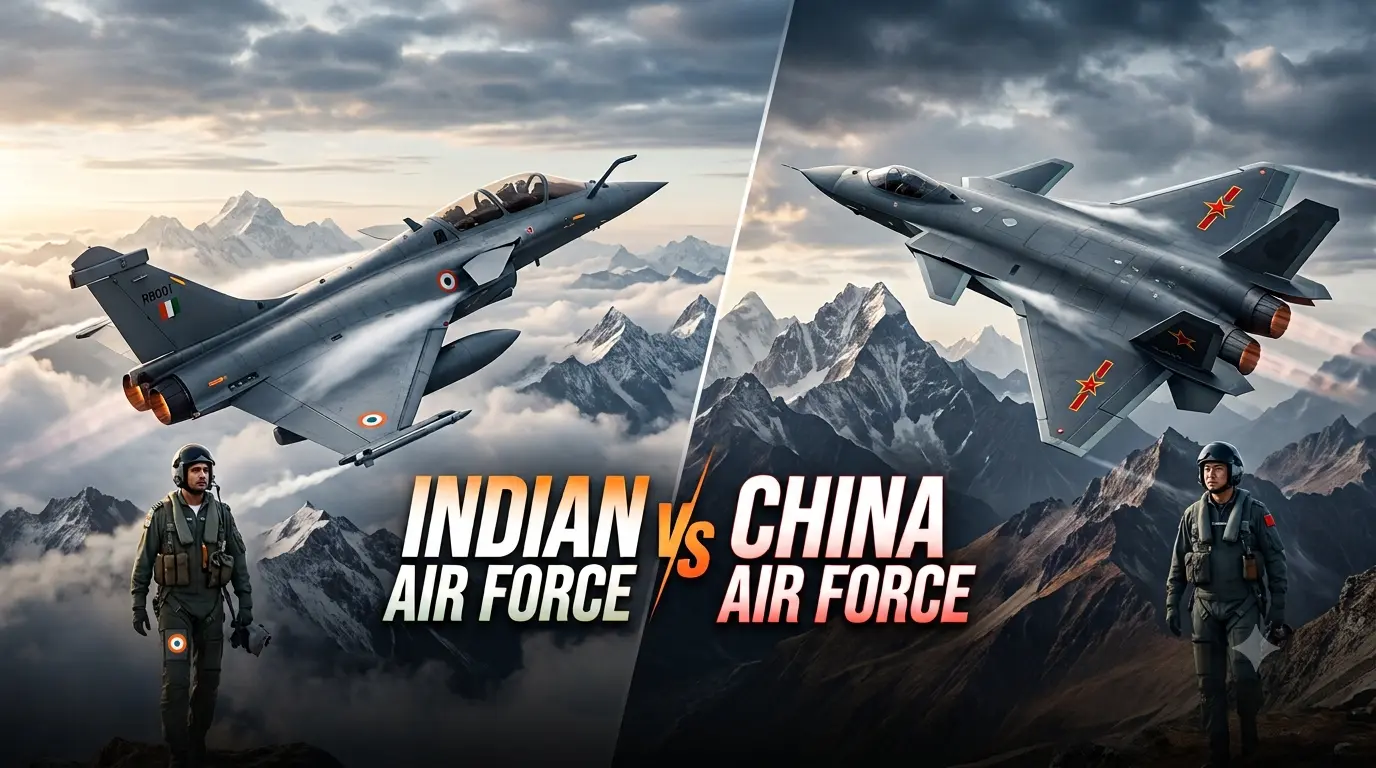

If you’ve scrolled defence Twitter this week, you’ve probably seen the headline: India’s air force just ranked above China’s. Again.
That’s not clickbait. It’s the actual finding of the 2026 Global Air Powers Rankings, published by the World Directory of Modern Military Aircraft (WDMMA). But the headline alone tells you almost nothing about what’s actually going on underneath it. And that’s where most of the coverage this week has gotten lazy.
Let’s fix that.
The Headline Number
The WDMMA’s 2026 rankings placed the Indian Air Force sixth in the world. The Chinese People’s Liberation Army Air Force (PLAAF) came in seventh, right behind it.
That one-spot gap is what every outlet is running with. Fair enough — it’s a real result, not a rounding error, and it’s the fifth year running that India has out-scored China on this particular index.
But here’s the number that actually matters, and the one most headlines buried: China operates roughly 3,733 aircraft. India operates about 1,716. China has more than double the fleet — and still finished behind India.
That’s not a typo. It’s the entire story.
How WDMMA Actually Scores an Air Force
WDMMA doesn’t just count planes. It runs everything through something called a True Value Rating (TvR) — a formula that weighs fleet diversity, modernisation, logistics, special-mission assets, and force balance, not just raw numbers.
Under that formula, the IAF scored a TvR of 69.4. The PLAAF scored 63.8.
Think of it like comparing two companies by revenue versus profit margin. China wins on top-line headcount every time. India wins when the metric shifts to how well-rounded and mission-ready the fleet actually is — transport, refuelling, electronic warfare, and fighters working as one system instead of one very large pile of aircraft.
Worth noting: this is one index, not gospel. WDMMA is a respected, independently run resource, but it’s still one methodology among several. Global Firepower, a separate and equally well-known index, tells almost the opposite story at the whole-military level — more on that below.
Where China Still Wins, Decisively
I’d be doing you a disservice as a journalist if I let the “India beats China” headline stand unchallenged, because it doesn’t hold up once you zoom out from air power to overall military strength.
The 2026 Global Firepower Index — a completely separate, 60-plus-factor review of 145 nations — ranks China third in the world overall, with a Power Index score of 0.0919. India sits fourth, at 0.1346 (lower is stronger under GFP’s scoring). That’s a real, structural gap, not statistical noise.
China’s advantages there are hard to argue with:
- A far larger standing military and reserve base
- A rapidly expanding blue-water navy
- Faster progress on stealth aircraft like the J-20
- Heavier investment in drones, satellites, and integrated network-centric warfare — an area Chinese defence analysts specifically flagged as underweighted in the WDMMA methodology
And they pushed back hard. Chinese state-linked commentators, including a former PLA Navy officer, called the WDMMA result disconnected from real combat performance, arguing that an index measuring fleet balance can’t capture what actually wins a war.
They have a point, even if the framing is defensive. A model is a model. It’s not a battlefield.
The Uncomfortable Number Nobody Put in a Headline
Here’s what I think deserves more attention than either ranking: the IAF is currently flying 29 fighter squadrons against a sanctioned requirement of 42.
That’s not a ranking problem. That’s a readiness problem, and no index — WDMMA or otherwise — fully prices it in. India’s own defence planners have flagged the same shortfalls repeatedly: fewer mid-air refuellers than needed, gaps in airborne early warning systems, and thinner electronic warfare coverage than a two-front contingency would demand.
The fixes are already in motion — 180 indigenous Tejas Mk-1A jets on order, 114 Rafale jets under discussion, and the S-400 air defence system now integrated into India’s command network. But “in motion” and “closed” are different words, and the squadron math won’t lie just because a global index looks favourable this year.
So Who’s Actually Ahead?
Depends entirely on what you’re measuring, and I’d rather give you the honest, split answer than a tidy one that flatters either side.
On fleet quality, balance, and mission-readiness per aircraft — the metric WDMMA is built around — India edges ahead. That’s a genuinely earned result, not a fluke, and it reflects real modernisation choices India has made over the past several years.
On raw scale, force depth, and overall military power — the metric Global Firepower is built around — China is comfortably ahead, and has been for years.
Neither number cancels the other out. They’re answering different questions. The mistake — and it’s one a lot of this week’s coverage made — is treating one index as the final word on a rivalry this complex.
As someone who’s spent enough time in defence reporting to be skeptical of any single-number ranking, here’s where I land: rankings like these are useful as a snapshot, dangerous as a conclusion.
WDMMA’s result is real and it says something genuinely positive about how India has prioritised modernisation over raw quantity. But squadron shortfalls don’t disappear because a TvR formula favoured balance over bulk this year. And China’s pushback, however defensive it sounds, isn’t wrong that drones, satellites, and network warfare are underweighted in a rankings model built primarily around aircraft.
The real story isn’t “India beat China.” It’s that two very different militaries are optimising for two very different kinds of strength — and the index you trust says more about what you value than about who’d actually win.
You May Also Read: