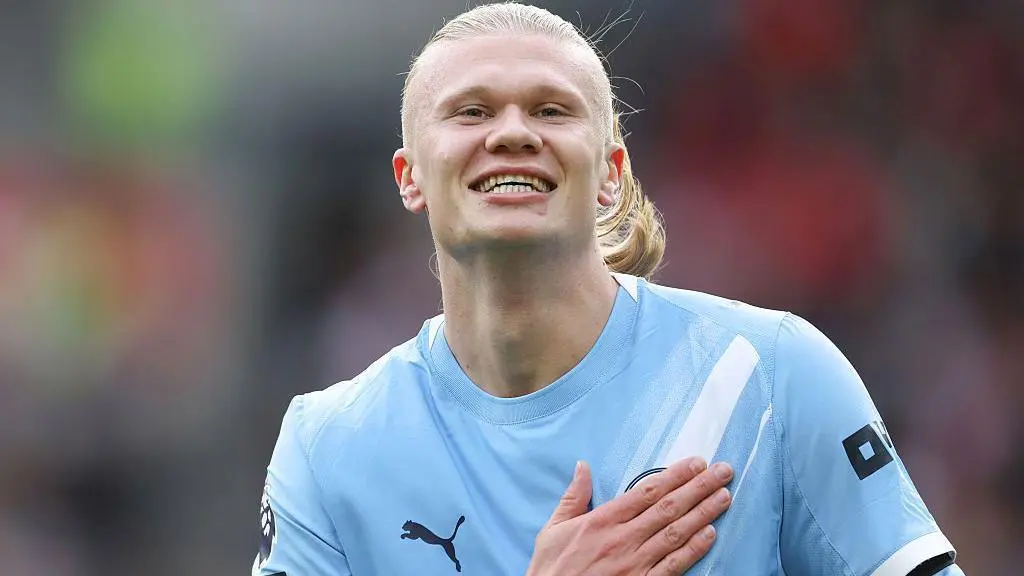

In 2022, I wrote an article claiming Erling Haaland would never win a World Cup with Norway. A World Cup hadn’t even happened yet — that’s how confident I was. Norway hadn’t sniffed a tournament since 1998, and I figured a nation that couldn’t qualify a golden generation featuring Martin Ødegaard wasn’t about to qualify one built around a striker, no matter how many nets he was ripping apart in Manchester.
Was I wrong? Sort of. Was I right? Also sort of. That’s the maddening, magnificent thing about covering this guy — he keeps forcing you to hold two contradictory thoughts at once.
Here’s what I mean. Haaland just led Norway to their first World Cup in 28 years. He scored 16 goals in eight qualifiers, matching a European record, doubling the tally of the next-best scorer on the planet. He then dragged Norway to the quarterfinals, beat Brazil to get there, and had the whole internet — and I mean the whole internet — calling him Norway’s World Cup machine. And then, on July 11th, England neutralized him, Bellingham scored twice, and Norway’s fairytale ended in the semifinal. Subbed off late. Tournament over.
So which is it? Vindication or humbling? Honestly — both. That’s Haaland in a sentence.
The kid who was never supposed to run properly
Erling Braut Haaland was born on July 21, 2000, in Leeds, England, while his father, Alf-Inge Haaland, was playing Premier League football for Leeds United. Alf-Inge — a defensive midfielder who also turned out for Nottingham Forest and Manchester City — is a name English football fans of a certain age remember for reasons that have nothing to do with his son (a nasty tangle with Roy Keane, if you want to go down that rabbit hole). His mother, Gry Marita Braut, was a Norwegian heptathlon champion, an elite track-and-field athlete in her own right. So basically: the kid was assembled in a lab built from two different flavors of elite athlete, except the lab was a small town in southwestern Norway.
The family moved back to Bryne when Erling was three. And here’s the detail I actually love, the one that makes the whole “generational athlete” myth feel almost too on-the-nose: Norwegian outlets have reported that a young Haaland once had an awkward, ungainly running style — the kind of thing that makes you wonder how someone destined to be one of the fastest strikers alive started out looking like he couldn’t get out of his own way. He also reportedly set an age-group world record in the standing long jump at age five, jumping 1.63 meters. Somewhere between “couldn’t run properly” and “world-record long jump as a toddler,” a monster was being built.
He joined Bryne FK’s academy at five. Made his senior debut for Bryne three months before turning 16. Molde FK picked him up next, in Norway’s top flight, and that’s really where the ignition switch flipped — under Ole Gunnar Solskjær, no less, a man who knows a thing or two about being a lethal, unassuming Norwegian striker in someone else’s country.
Salzburg, Dortmund, and the goals that got genuinely absurd
From Molde it was Red Bull Salzburg, then in January 2020, Borussia Dortmund — where things stopped being merely impressive and started being borderline unbelievable. He scored a hat-trick in 23 minutes on his Dortmund debut. Became the first player in Bundesliga history to score five goals in his first two league games. Once put four past Hertha Berlin in 32 minutes. By the time he was 20, “wonderkid” wasn’t even the right word anymore. He was just a problem — a physics problem, really, for anyone standing between him and goal.
Turning down Real Madrid to sign for a fraction of his value
In 2022, Manchester City signed Haaland, reportedly turning away serious interest from Real Madrid and Barcelona to do it — and by most accounts, City got him for less than his actual market value. That’s the kind of transfer that looks, in hindsight, like one of the great bargains in modern football. His debut Premier League season, he broke the single-season scoring record with 36 goals and helped City win the continental treble — Premier League, FA Cup, Champions League, all in one year, the first time any English club had managed it.
He hasn’t slowed down since. Three Golden Boots in four seasons. Fastest player ever to 100 Premier League goals — 111 appearances, beating Alan Shearer’s three-decades-old record. Fastest to 50 Champions League goals. In January 2025, he signed a contract extension with City reportedly running until 2034 — the longest deal in Premier League history, and one without, according to those close to him, any release clause, despite a wave of Real Madrid speculation earlier this year that his own camp had to publicly shut down.
Family, quietly, in the background
For someone this famous, Haaland keeps an unusually tight lid on his personal life. He’s been with Isabel Haugseng Johansen — also from Bryne, also a footballer — since they were teenagers. They welcomed a son together in December 2024. That’s essentially all he’s confirmed publicly, and he seems to want to keep it that way, which is almost refreshing in an era where every footballer’s private life doubles as content.
His father still travels with him to major transfers and big decisions. His mother’s athletic pedigree gets cited constantly as shorthand for “this is where the genes came from.” And there’s an entire extended Braut-Haaland footballing family tree — cousins playing professionally across Europe — that makes you wonder if Norway just has one enormous gene pool reserved exclusively for strikers.
The World Cup he’d been waiting his whole career for
This is the part of the story that actually gets me, journalist hat off for a second. Despite scoring over 370 career goals, Haaland had never played in a major international tournament before this summer. Not one. Norway missed the 2022 World Cup and Euro 2024, and Haaland — sidelined by injury for key qualifiers in that stretch — has talked about how much that absence genuinely hurt. Not “disappointing season” hurt. Actual anguish.
So the 2026 qualifying campaign became personal. Sixteen goals in eight games. Scored in every single one. Named captain, already Norway’s all-time leading scorer. He wore “Braut Haaland” on the back of his shirt through the tournament, honoring his mother’s side of the family, which tells you something about what this run meant to him beyond the stat sheet.
Norway arrived in North America as underdogs with a superstar, not genuine title contenders — but with Haaland and Ødegaard both in the same XI, nobody wanted to draw them in a group. They beat Brazil to reach the quarterfinals for the first time in the country’s history. Then England ended it in the semifinal, 2-1, Bellingham doing the damage, Haaland shut down for most of the night and subbed off late.
That’s how it ends, for now. Not a trophy. Not even a final. But the first World Cup semifinal Norway has ever reached, carried there by a 25-year-old who spent his entire career being told his country simply didn’t do this.
So — who is Erling Haaland, really?
Take away the goals, the records, the reported billion-euro valuation his agent likes to float, and you’re left with a guy from a small town near Stavanger who apparently couldn’t run properly as a kid, who keeps his relationship and his son almost entirely out of the public eye, who still travels with his dad to big decisions, and who wore his mother’s name on his back at the biggest tournament of his life because it mattered to him more than it mattered to anyone covering it.
I’ve been wrong about him before, and I’ll probably be wrong about him again — that’s the tax you pay for covering someone whose ceiling nobody’s actually found yet. But if this World Cup proved anything, it’s that betting against Haaland is usually just a way of embarrassing yourself a few years early.
Common Questions About Erling Haaland
How old is Erling Haaland? Haaland was born on July 21, 2000, in Leeds, England, making him 25 years old as of 2026.
Who are Erling Haaland’s parents? His father is Alf-Inge Haaland, a former Premier League defensive midfielder who played for Nottingham Forest, Leeds United, and Manchester City. His mother, Gry Marita Braut, was a Norwegian heptathlon champion and elite track-and-field athlete.
Does Erling Haaland have children? Yes. He and longtime girlfriend Isabel Haugseng Johansen, also from his hometown of Bryne, welcomed a son in December 2024.
Is this Erling Haaland’s first World Cup? Yes. Despite scoring more than 370 career goals, the 2026 World Cup was Haaland’s first major international tournament appearance, as Norway had missed the previous two major tournaments.
How did Norway’s 2026 World Cup run end? Norway reached the quarterfinals for the first time in its history, beating Brazil to get there, before losing 2-1 to England in the semifinal on July 11, 2026.
You May Also Read: