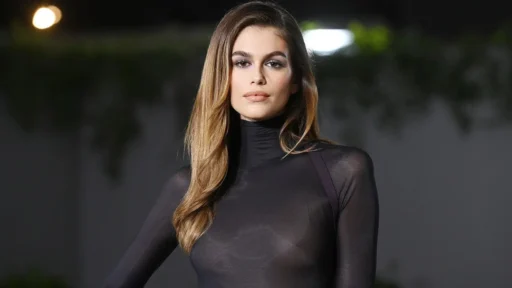
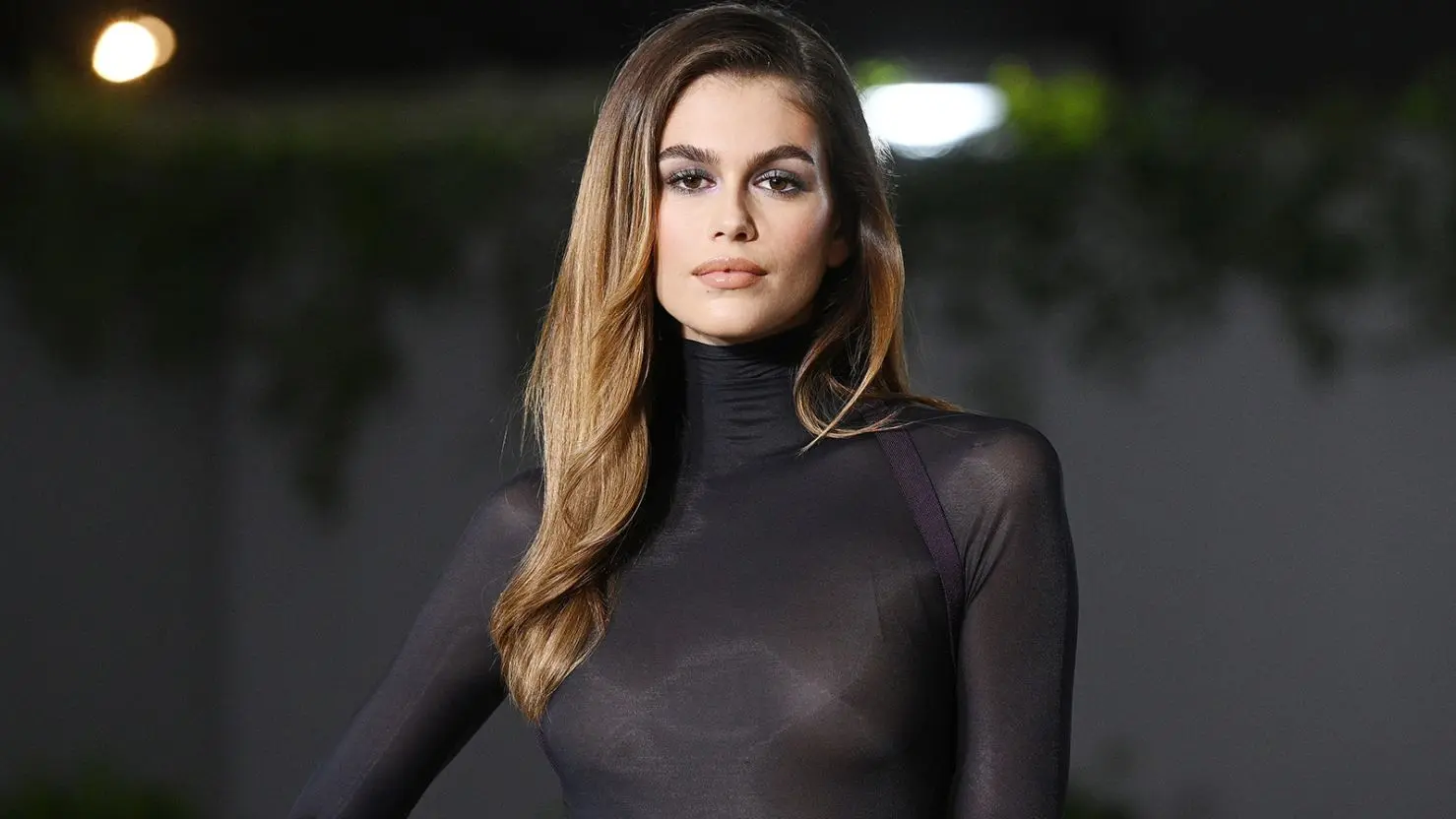

There’s a particular kind of face that stops you mid-scroll. Not because it’s flawless — plenty of faces are flawless and forgettable — but because it feels familiar, like you’ve seen it somewhere before you actually have. That’s the effect Kaia Gerber has had on me every single time she’s shown up in my feed for the past decade. And for a long time, my reaction to that face was, honestly, a little ungenerous. “Of course she’s a model,” I’d think. “Her mother is Cindy Crawford. That’s not a career, that’s a birthright.”
It’s the same poisonous little thought I get when I finish a book that wrecks me — that quiet voice that says some people just get the good stuff handed to them. Except this time I decided to actually check my math instead of just resenting it from a distance. So I went down the rabbit hole. Turns out the story is messier, more interesting, and honestly a little more admirable than the one-line nepotism take I’d been carrying around for years.
Kaia Jordan Gerber was born on September 3, 2001, in Los Angeles, the younger of two kids belonging to supermodel Cindy Crawford and businessman (and former model himself) Rande Gerber. Her older brother, Presley, got there first — both in birth order and, briefly, in the modeling world.
Kaia’s dad is of Algerian Jewish descent; her mom carries German, English, French, and Danish roots and was raised Christian. Kaia’s described the household as a kind of hybrid holiday economy — Passover dinners next to Christmas mornings, a blended thing she once nicknamed “Chrismukah,” which is objectively a great word and I’m mad I didn’t think of it first.
So yes — the genetics were never in question. What’s more interesting is what she actually did with them.
Here’s the part that reframed things for me: Kaia’s first modeling job came at age ten, for Young Versace, the brand’s junior line. Ten. That’s an age where most of us are still negotiating bedtimes, not shooting campaigns. She spent her adolescence quietly building a résumé — a Teen Vogue feature at thirteen, an acting debut at fifteen in the little-seen film Sister Cities — all while doing school online out of Malibu, apparently keeping her grades up because, as she’s told interviewers more than once, her mother made academics the non-negotiable part of the deal.
Then came 2017. She signed with IMG Models, and at sixteen she opened Alexander Wang’s Spring/Summer show — the kind of placement that isn’t given away, even to a famous last name. That same fashion season she walked in Raf Simons’ Calvin Klein Collection debut and then, during Spring 2018 Fashion Week, walked for what feels like the entire industry roster: Chanel, Prada, Fendi, Givenchy, Valentino, Saint Laurent, Alexander McQueen, Miu Miu, Bottega Veneta — the list runs long enough that it stops reading like a career and starts reading like a coronation. At one show, she walked alongside her own mother, which is either the most surreal family outing imaginable or just a Tuesday in that household.
The Cover, the Crown, the Contradiction
By February 2018, at sixteen, she’d landed her first solo cover for Vogue Paris. In 2018 she also won Model of the Year at the British Fashion Awards — an award voted on by an industry that, whatever you think of nepotism, isn’t in the business of handing out trophies out of sentimentality. She became the face (and eventually a beauty ambassador) for YSL Beauty, fronted Marc Jacobs’ Daisy campaign, and by 2020 was the subject of a Louis Vuitton campaign shot by Craig McDean. In 2021 she made her American Vogue cover debut — twice that year, in fact — becoming, notably, the first model from the 2000s generation to land one of the “Big Four” Vogue covers.
Here’s the contradiction that actually made me like her: somewhere in the middle of all that ascension, she was also just… a kid with a book habit. She’s talked openly about reading being one of the only parts of her life that felt fully hers — not inherited, not photographed, not curated for anyone. She eventually turned that into “Library Science,” a book club-meets-podcast project, interviewing authors instead of designers for once. It’s a small pivot, but it’s the kind of detail that tells you more about a person than any runway ever could.
Modeling wasn’t the ceiling — it was the launchpad. Gerber moved into acting with a supporting role in American Horror Story: Double Feature in 2021, then Babylon (2022), Bottoms (2023), and Saturday Night (2024). None of these are lead roles that carry a film on her name alone, and to her credit, she doesn’t seem to be rushing that. It reads like someone building range on purpose rather than cashing in a famous face for a fast Hollywood detour.
I’ll be honest, this is the section I almost skipped, because it feels like the least interesting thing about her — but it’s also the thing search engines insist on knowing, so here it is: she dated comedian Pete Davidson briefly around late 2019 into early 2020, then actor Jacob Elordi from 2020 to 2021, followed by a longer relationship with Austin Butler from December 2021 that reportedly ended around early 2025.
More recently she’s been linked to actor Lewis Pullman. None of it seems to define her the way the headlines want it to — she’s been fairly guarded about the private stuff, which, in an industry built on exposure, is its own quiet act of control.
So — Nepo Baby, or Something Else?
I went into this expecting to confirm my own cynicism, and instead I came out mildly impressed, which is an annoying thing to admit. Yes, Kaia Gerber had a door opened for her that most people never get near. But doors don’t walk through themselves, and they definitely don’t win Model of the Year, land four solo Vogue covers, or get cast in four films across three years just because your mom was famous once. Somewhere between the Versace catalog at ten and the Vogue cover at sixteen, there’s an actual work ethic in there — the kind that doesn’t make for a flashy headline, but is probably the only real explanation for a career this durable.
Maybe that’s the lesson buried in all of this, the one I didn’t expect to land on: inheritance can get you into the room. It’s never once been enough, on its own, to keep you in it.